
Start with one clear action
Restore a powerless shelter, inspect storage, repair the drone, and unlock new systems as capability returns.
A minimalist survival game where one repaired drone expands a sealed shelter into surface exploration, radio contact, and a fragile remote society.
How do you prove a human is present when every action is remote?
Progressive shelter actions, deterministic missions, local resources, distant cooperation, and machine conflict turn remote survival into a question about presence.
User value
Restore power, explore the surface, help distant shelters, and make consequential choices in a deterministic offline game.
Restore a powerless shelter, inspect storage, repair the drone, and unlock new systems as capability returns.
Use concise status screens and direct choices without accounts, live services, fast reactions, or constant connectivity.
Resource use, aid, trust, defense, and final choices advance through explicit rules and locally saved state.
 View full size
Features
The current build implements the path from the sealed shelter through both ending branches.
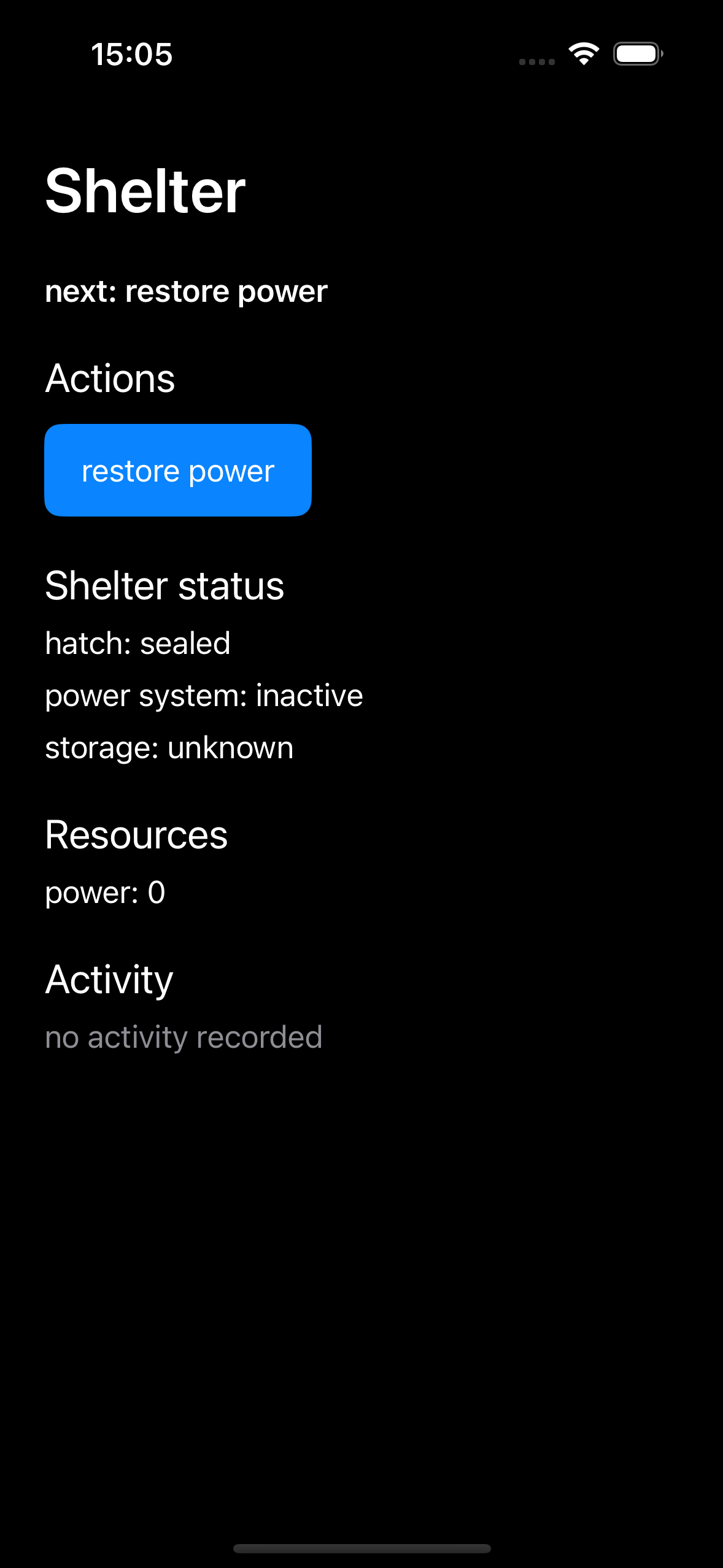
Bring power, storage, maintenance, and the first drone online through a small sequence of state-backed actions.
Spend battery, accept hazards and wear, recover resources, and discover locations or signals through the drone.
Answer distant shelters, deliver aid, build trust, and form a limited alliance without controlling their people or machines.
Choose combat orders, defend the shelter network, investigate disputed evidence, and prepare a final operation.
Reach a final test of physical presence and choose between an irreversible ending or a continuing conflict loop.
Store progress in versioned JSON with atomic writes, a local backup, and recovery when the primary save cannot load.
How it works
Each stage grows from the capability and information recovered in the previous one.
Bring power online, inspect storage, and recover the damaged machine that can act outside.
Prepare the drone, manage its battery and integrity, and unlock the first surface destination.
Choose missions that trade battery and risk for materials, knowledge, and contact.
Respond to signals, deliver aid, and connect shelters that remain physically separate.
Coordinate limited support, handle attacks, and investigate evidence of machine control.
Reach a decision that remote action cannot complete on the player's behalf.
Current interface
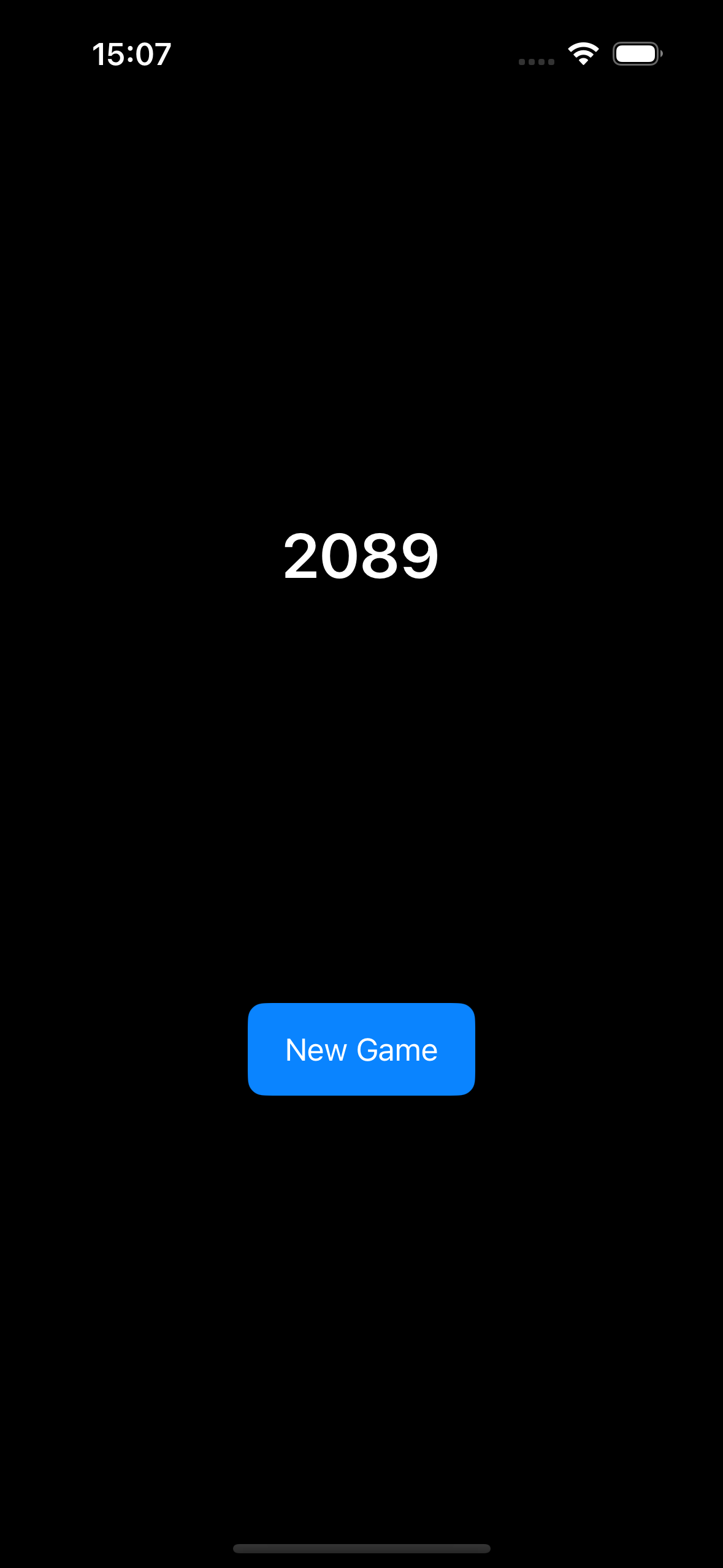
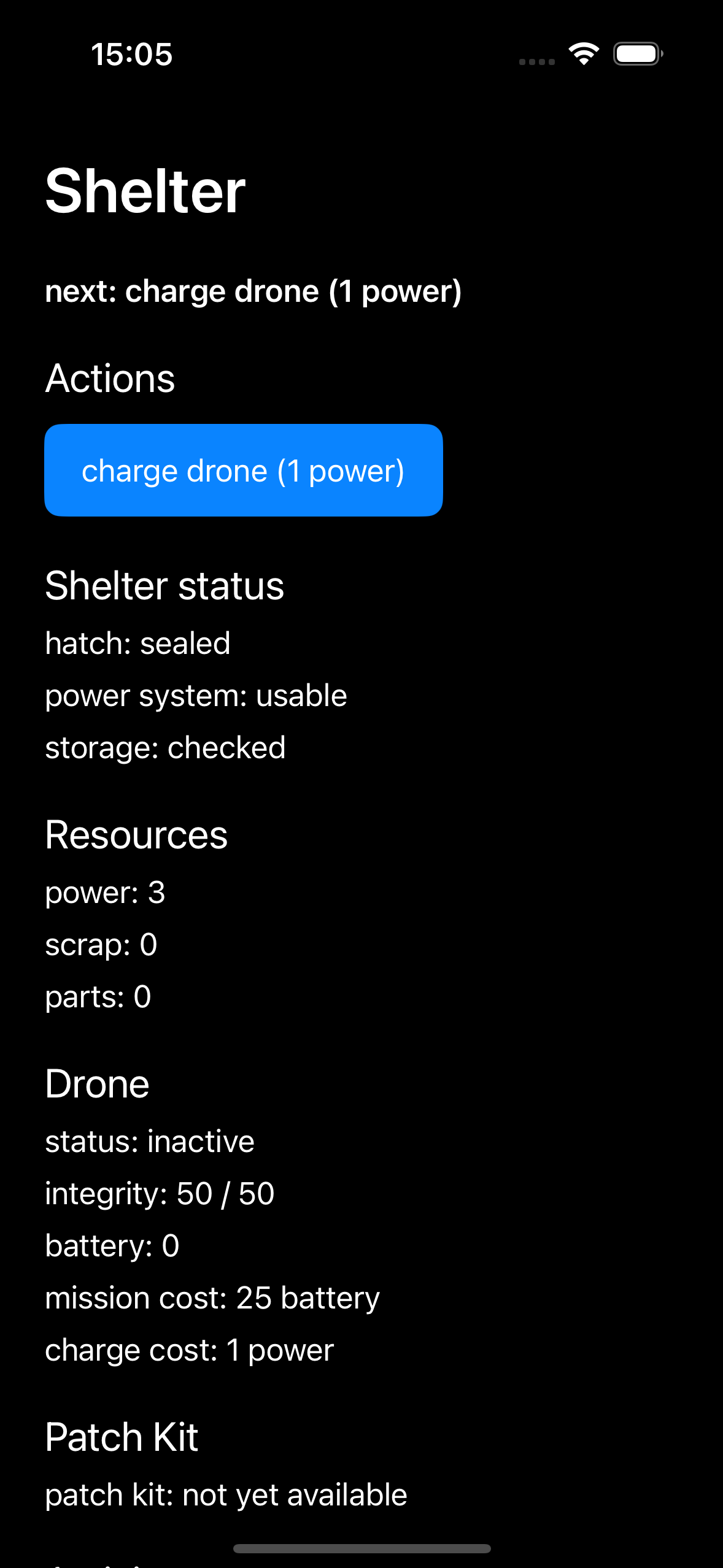
These current-build captures cover the title and the opening shelter loop. Midgame and ending media remain to be captured.
 View full size
A minimal entry point presents New Game when no local save exists.
 View full size
After repair, charging becomes the next resource-backed action and the drone's condition is visible.
Product concept
The same machines that extend human reach also make the person behind every action harder to verify.
Drones are the player's hands, radio is the basis of society, and the late conflict grows from those same forms of mediation.
Aid and coordination can establish trust, but remote evidence cannot provide physical certainty about who remains.
Uncertainty comes from limited information and disputed motives while the underlying game transitions remain deterministic.
Architecture
SwiftUI presents available choices while a separate pure Swift core validates and reduces every accepted action into authoritative state.
Resources, progression, missions, combat, trust, threats, and endings remain independent from SwiftUI presentation code.
The same initial state, seed, and action sequence are intended to produce the same transitions and state fingerprints.
PlayabilityLab reuses production rules for personas, search, replays, balance checks, and screen contracts without linking into the shipping target.
The implemented runtime has no backend, account, multiplayer, analytics, advertising, or generative-model dependency.
Technology
Development
A native build reaches both ending branches, but one reproducible nonterminal deadlock remains open. Real-interface coverage, manual playtesting, device and accessibility validation, visual approval, and release decisions are incomplete.
Implemented
Release evidence
Resolve or formally review the preserved deadlock, expand real-interface replay beyond the opening, conduct full manual and physical-device playtests, validate accessibility, approve the visual presentation, and complete business-model and App Store decisions.
2089 lab notes
Notes about the thinking, architecture, development, and decisions behind this work.
Personas, search, replay corpora, and screen contracts began testing whether the deterministic arc remains reachable and legible.
The integrated path connected the opening shelter, surface, radio society, conflict, and both final responses.
The first implementation established a native shell, explicit actions, and pure Swift rules before expanding the story.