
Retain local control
Keep the implemented session, audio, transcript, candidates, note, and review artifacts in one deletable app-container folder.
A local-first ophthalmology documentation assistant that turns consultation audio into evidence-linked, review-required draft notes under physician control.
What if clinical documentation assistance never obscured the boundary between evidence and inference?
Local sessions, consent-gated recording, supported on-device transcription, conservative candidate extraction, transcript evidence links, deterministic drafts, guardrails, and explicit review keep assistance inspectable.
User value
Move from consultation audio to a review-required ophthalmology draft while keeping evidence, uncertainty, and physician judgment visible.
Keep the implemented session, audio, transcript, candidates, note, and review artifacts in one deletable app-container folder.
Open the transcript text and timestamp that produced a candidate instead of accepting an unsupported summary.
Keep drafts and review prompts explicitly non-final so workflow actions never become clinical validation.
 View full size
Features
Each stage keeps source evidence, generated wording, and physician review separate.
Report device, operating-system, speech, language, and Foundation Models availability without inventing support when the runtime cannot verify it.
Create a local session, select one of five documentation languages, confirm consent, and record consultation audio as a local M4A file.
Use Apple speech services only when supported and persist timestamped transcript segments inside the consultation session.
Detect provisional vocabulary mentions, laterality, negation, and high-risk terms, then connect each candidate to transcript text and time ranges.
Render fixed ophthalmology sections from candidates and check draft claims against available evidence with inspectable rules.
Turn guardrail findings into local prompts with status transitions and history without treating any action as clinical approval.
How it works
The current implementation keeps the entire consultation pipeline inside one local session lifecycle.
Review local capability results and choose the documentation language before creating a consultation.
Add an optional title or patient reference and keep the new session inside the app container.
Pass the explicit consent transition, request microphone access, and capture a local audio file.
Create timestamped transcript segments through the conservative Apple speech boundary.
Identify bounded clinical mentions and retain the exact transcript segment and time range behind each one.
Generate deterministic sections, inspect guardrail prompts and audit state, then retain or delete the local session.
Current interface
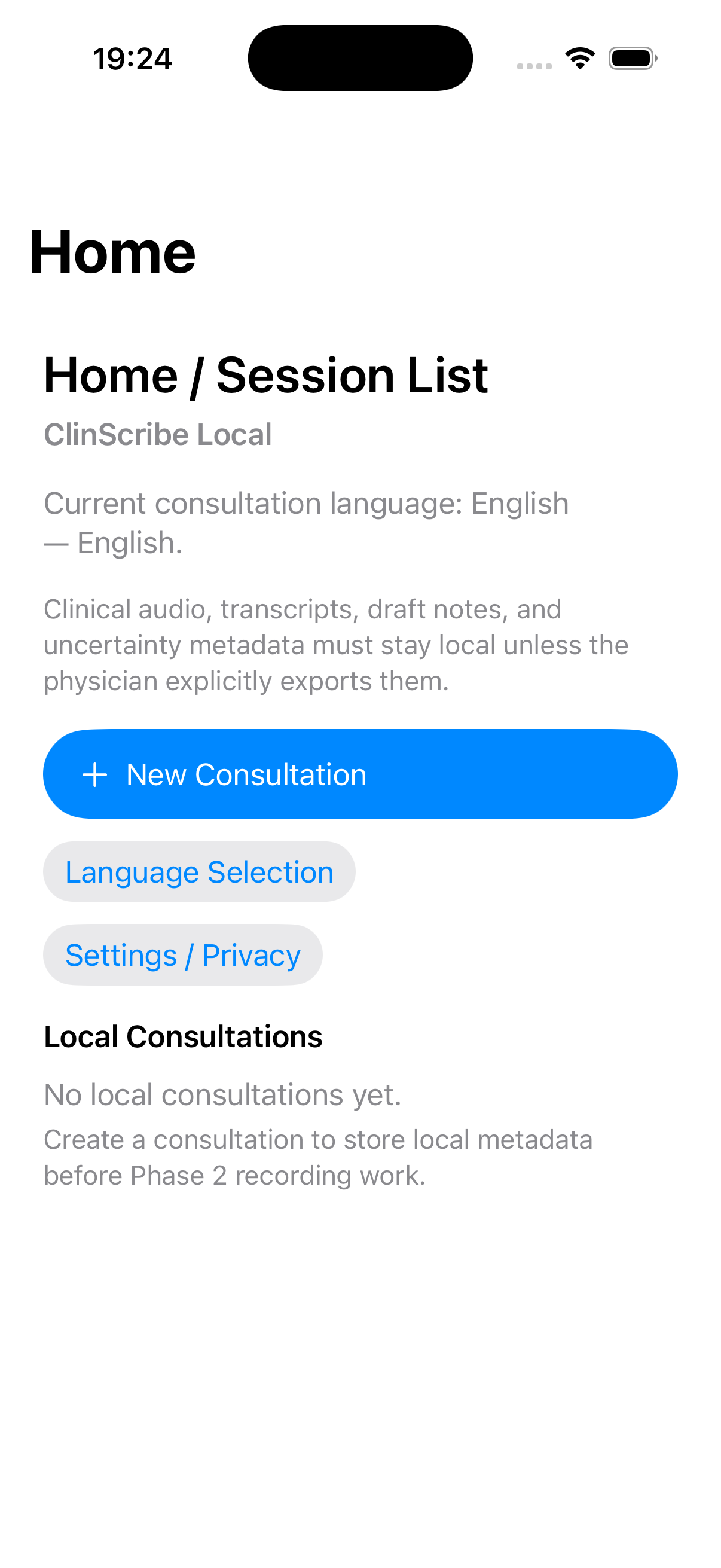
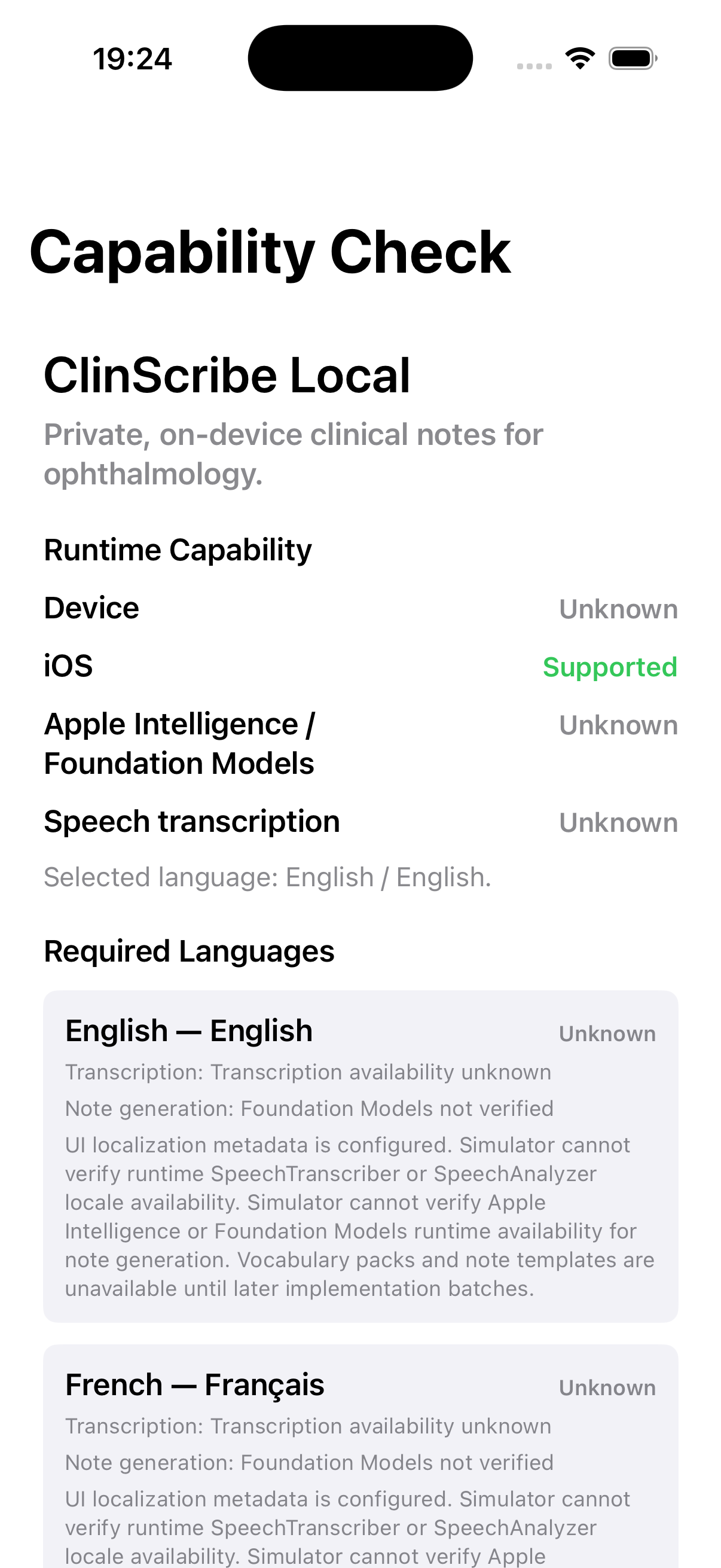
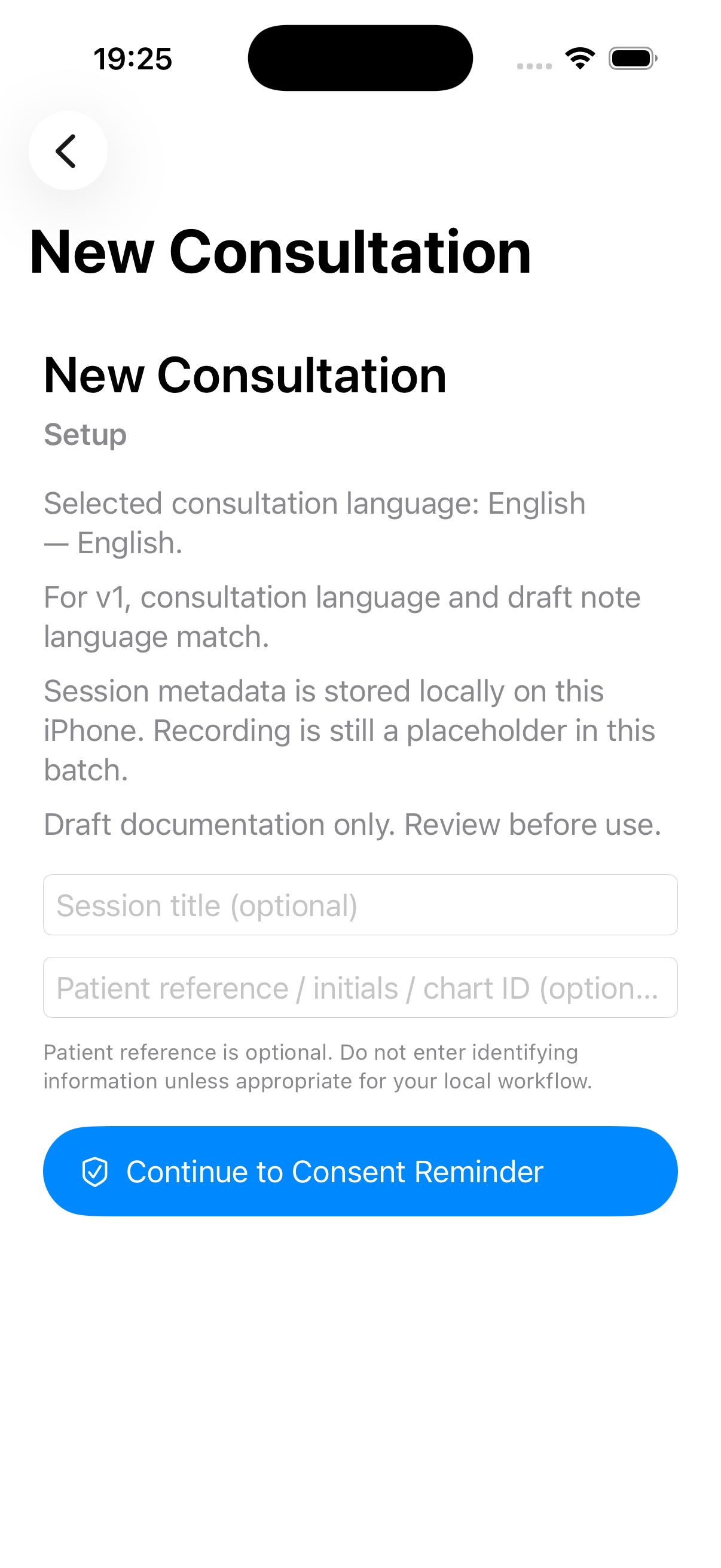
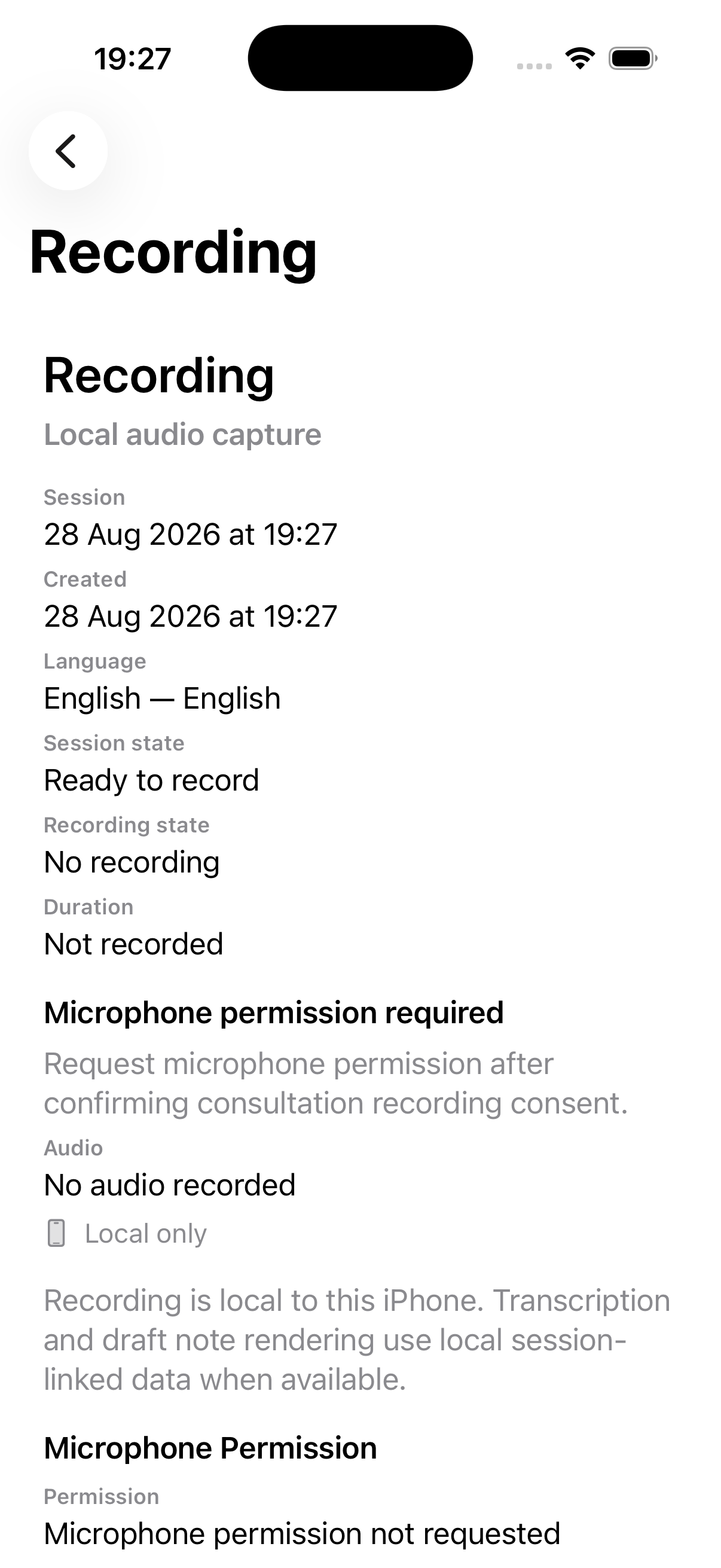
These simulator captures use empty or synthetic local sessions and large system text. They are development evidence, not clinical validation or final App Store media.
 View full size
The app reports what it can verify and leaves simulator-dependent speech and model capabilities visibly unknown.
 View full size
Language, optional identifiers, local-processing copy, and the consent transition appear before recording begins.
 View full size
The consultation screen keeps recording readiness, microphone permission, and local-only handling visible.
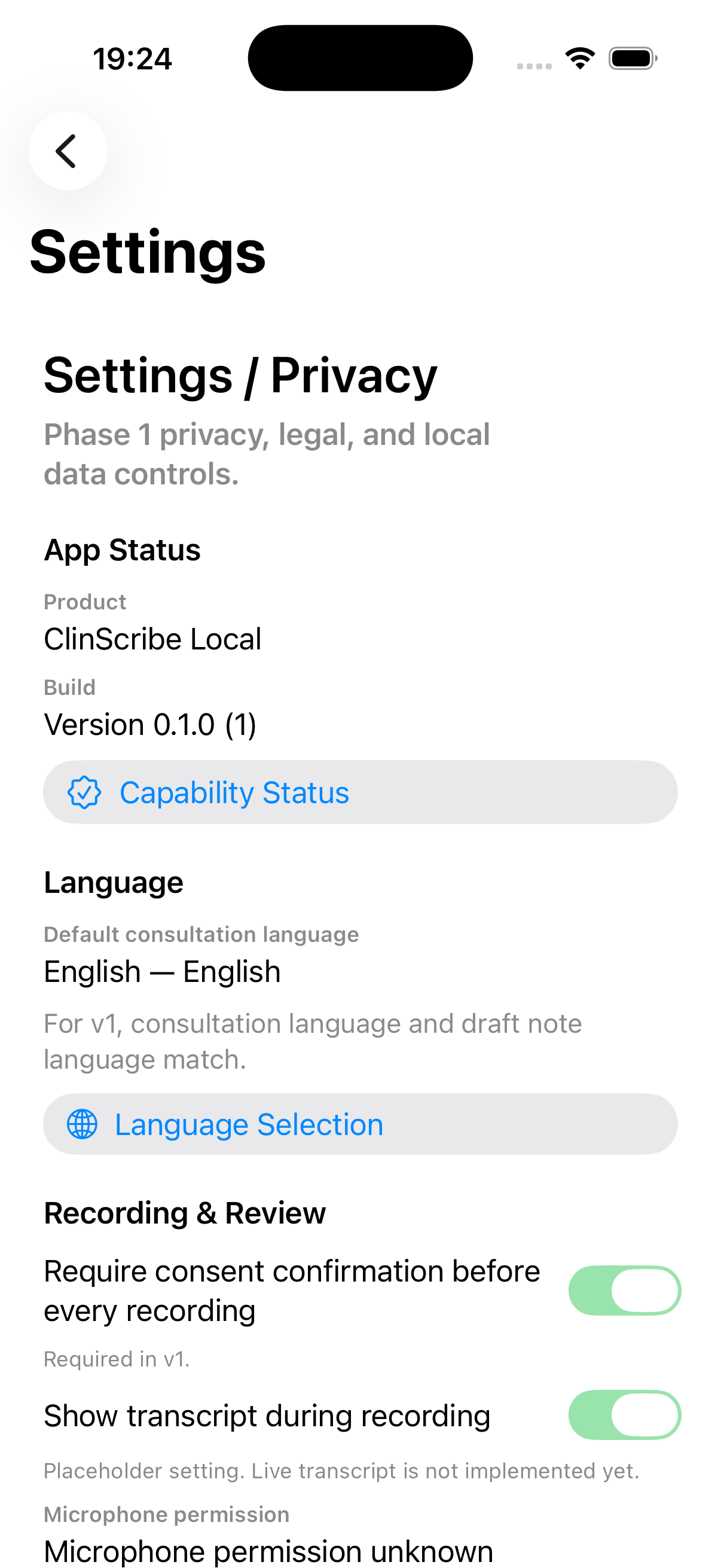 View full size
Language, consent, transcript, microphone, capability, and privacy settings remain available from one screen.
Product concept
The system can show where wording came from and where attention is needed without certifying a diagnosis, plan, or final note.
Extraction produces review-required candidates whose source is inspectable, not verified clinical assertions.
Generated sections remain working material and never become a final clinical record automatically.
Acknowledged, deferred, dismissed, rejected, resolved, and reopened describe workflow state, not medical correctness.
Architecture
A session folder owns the audio, transcript, candidates, draft, prompts, and audit artifacts from creation through deletion.
Application Support folders and local JSON keep related artifacts together and give deletion one bounded target.
Candidate extraction, section rendering, claim checks, and prompt mapping use explicit deterministic logic.
Foundation Models are represented as an availability and future integration boundary, not a production note generator.
Managed paths are excluded from backup, while physical-device file protection, uninstall behavior, and deletion completeness still require verification.
Technology
Development
The SwiftUI workflow, local persistence, recording boundary, transcript models, deterministic extraction, evidence links, draft rendering, guardrails, review prompts, audit actions, and deletion are implemented and test-backed. Real-device speech, clinical usefulness, multilingual safety copy, storage protection, accessibility, legal, regulatory, and release readiness remain unvalidated.
Implemented
Before clinical or public use
Complete manual and physical-device QA, obtain ophthalmologist and native-speaker review, verify storage and deletion behavior, resolve terminology governance and stale copy, complete legal, privacy, medical-regulatory, accessibility, and App Store review, and separately design any copy, export, EHR, or model-assisted generation path.
ClinScribe Local lab notes
Notes about the thinking, architecture, development, and decisions behind this work.
Draft issues became local prompts with status and audit history without becoming clinical validation.
Deterministic extraction, source links, guarded wording, and claim checks made traceability the central product mechanism.
The first implementation made each consultation a local, deletable session and every generated artifact review-required.