
Shape a living defense
Seed cellular growth where it can reach the path instead of placing permanent towers on fixed slots.
A portrait strategy game where the player grows a cellular defense, then protects or cuts it as invading bugs spread corruption through the same organism.
What if the battlefield were cultivated rather than constructed?
Seeded circuit boards, deterministic cellular growth, infection, direct touch tools, and short wave runs turn tower defense into the care of an unstable organism.
User value
Cultivate a living mold around the circuit path while bugs convert the same defense into spreading corruption.
Seed cellular growth where it can reach the path instead of placing permanent towers on fixed slots.
Protect valuable regions with Serum or cut away healthy and infected tissue before corruption spreads farther.
Use short portrait runs, clear energy and core states, deterministic seeds, and immediate restart to learn the system.
 View full size
Features
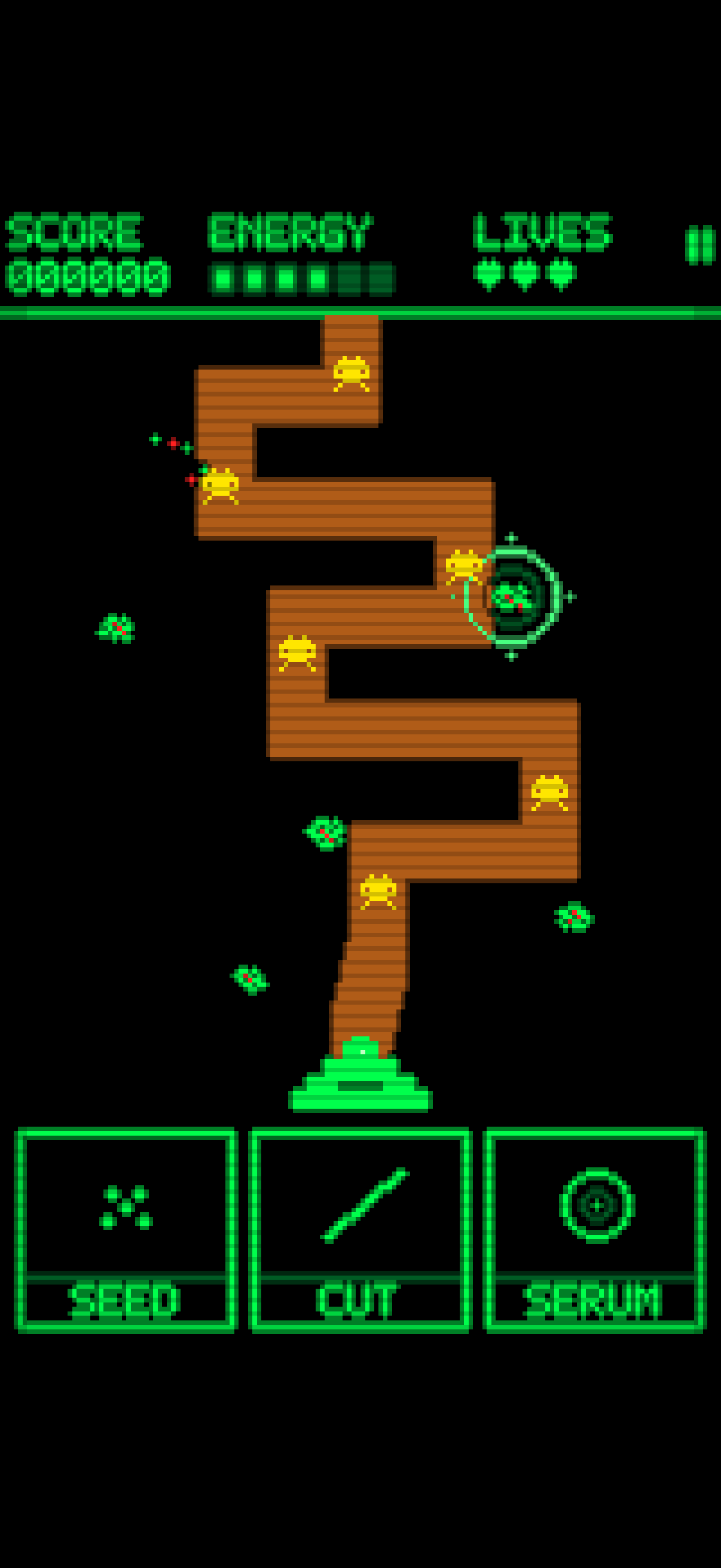
The current debug preview connects the central simulation, enemies, tools, resource economy, and run outcome.
Build a validated path from a deterministic seed and fall back to known-safe maps when generation fails.
Spread healthy mold under cellular rules, damage bugs on contact, and watch infection move through the colony.
Start new growth, remove organism cells without damaging terrain, or protect a healthy region temporarily.
Basic, Glitch, and Heavy bugs move along the circuit path during a provisional three-wave sequence.
Spend energy, use free seeds, earn enemy rewards, protect three core lives, and finish in a frozen win or loss state.
Render the 160 by 256 canvas, font, sprites, circuit path, effects, controls, and CRT treatment from code.
How it works
The current debug slice begins with a warm-up, then advances through three deterministic waves.
Create a seeded board with a validated path, playable regions, and a core at the end.
Inspect the board, test the three tools, and place initial growth before the first wave begins.
Spend a free use or energy to start mold near positions that can damage passing bugs.
Watch enemy contact create red corruption that can travel through the same healthy colony.
Apply Serum to preserve a valuable region or drag Cut through tissue to contain a larger threat.
Clear the final preview wave or lose all core lives, inspect the run metrics, and tap to retry the seeded slice.
Product concept
Healthy mold is a weapon, shield, resource, and potential route for the corruption that can destroy it.
The player shapes an evolving organism rather than arranging a permanent set of static towers.
Seed encourages growth, Serum preserves it, and Cut accepts local loss to contain a wider failure.
Seeded randomness, fixed update order, explicit states, and short runs make the changing board learnable and reproducible.
Architecture
The simulation remains independent from SpriteKit so maps, cellular behavior, enemies, tools, and run outcomes can be tested without a scene.
Pure Swift types manage the board, map, organism, enemies, waves, resources, scoring, and result state without importing SpriteKit.
Cut can remove mold above a path or core without destroying the terrain that defines movement and the objective.
A seeded generator, fixed five-tick-per-second rate, and explicit update order make diagnostic scenarios reproducible.
The source contains no network, account, backend, analytics, advertising, in-app purchase, Game Center, or cloud-save path.
Technology
Development
Generated maps, cellular growth, corruption, enemies, three tools, energy, core lives, provisional waves, result states, and restart are integrated. Release builds still show a black canvas, and production flow, final content, persistence, audio, balancing, comfort settings, and device validation remain incomplete.
Implemented
Production transition
Connect the accepted slice to title, tutorial, pause, settings, and result routing; finish the five-wave structure and boss; integrate local saves and comfort settings; add audio and haptics; then validate controls, balance, readability, and performance on iPhones.
Cellular Siege lab notes
Notes about the thinking, architecture, development, and decisions behind this work.
Seed, Cut, Serum, enemies, corruption, energy, core lives, and results became one reproducible three-wave debug run.
The staged pixel board became seeded map data that later mechanics could grow across, defend, and corrupt.
A native SwiftUI and SpriteKit shell, fixed pixel canvas, and deterministic simulation boundary established the game's technical form.