
Recover the larger reason
Connect today's difficulty to the goal, transformation, practice, and obstacles stored for the active Path.
A private, local-first sensei that reconnects everyday practice to the larger Path a person chose.
What if guidance protected meaning instead of measuring productivity?
Structured Path memory, voluntary conversation, practice context, reflection, and guarded on-device generation turn a moment of drift into one honest next action.
User value
Mister M helps when the next action is known but its connection to the larger direction has gone quiet.
Connect today's difficulty to the goal, transformation, practice, and obstacles stored for the active Path.
Use reviewed local context to shape a response instead of treating every moment as generic motivation.
Come voluntarily, keep daily conversation on device, and continue without streaks, shame, or automatic cloud fallback.
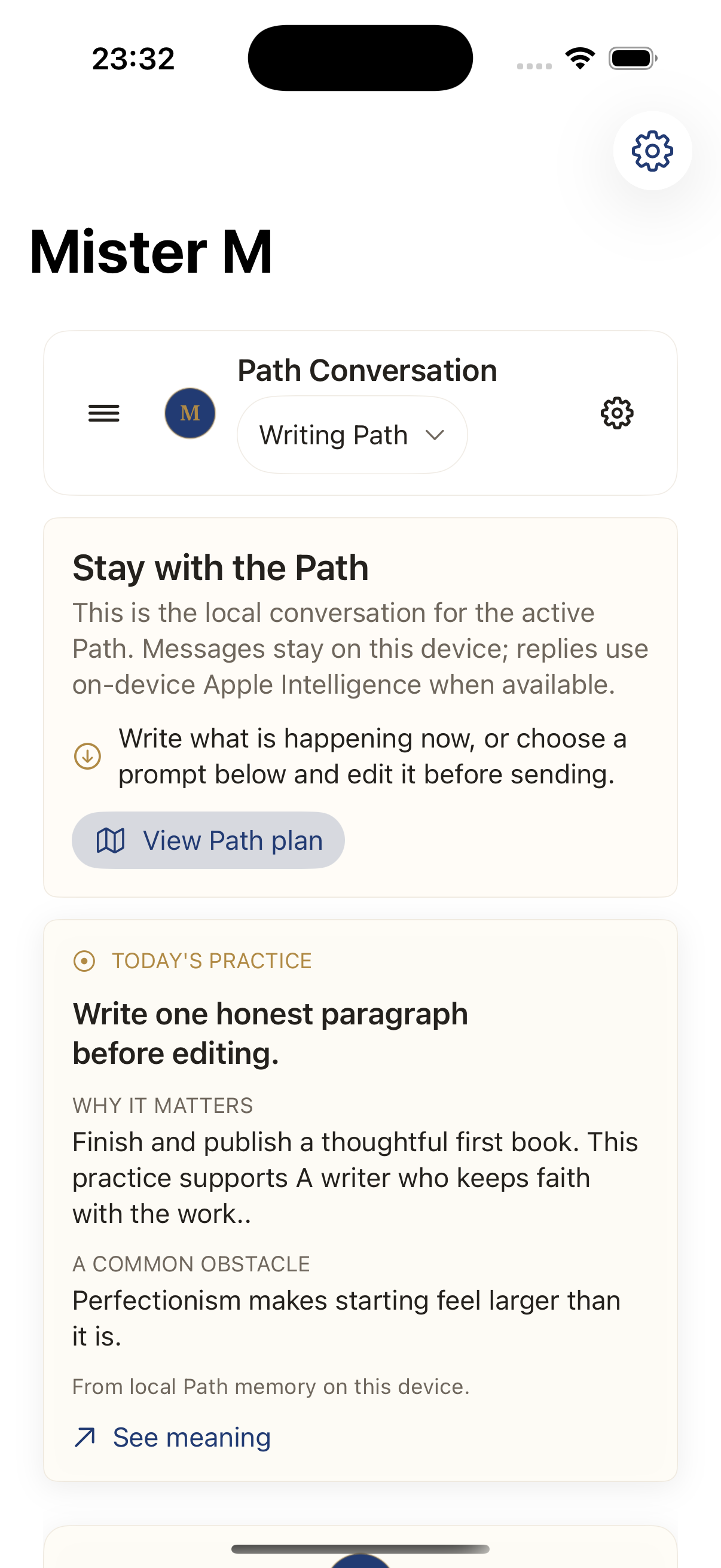 View full size
Features
The current build connects Path setup, conversation, practice, reflection, memory, and plan review.
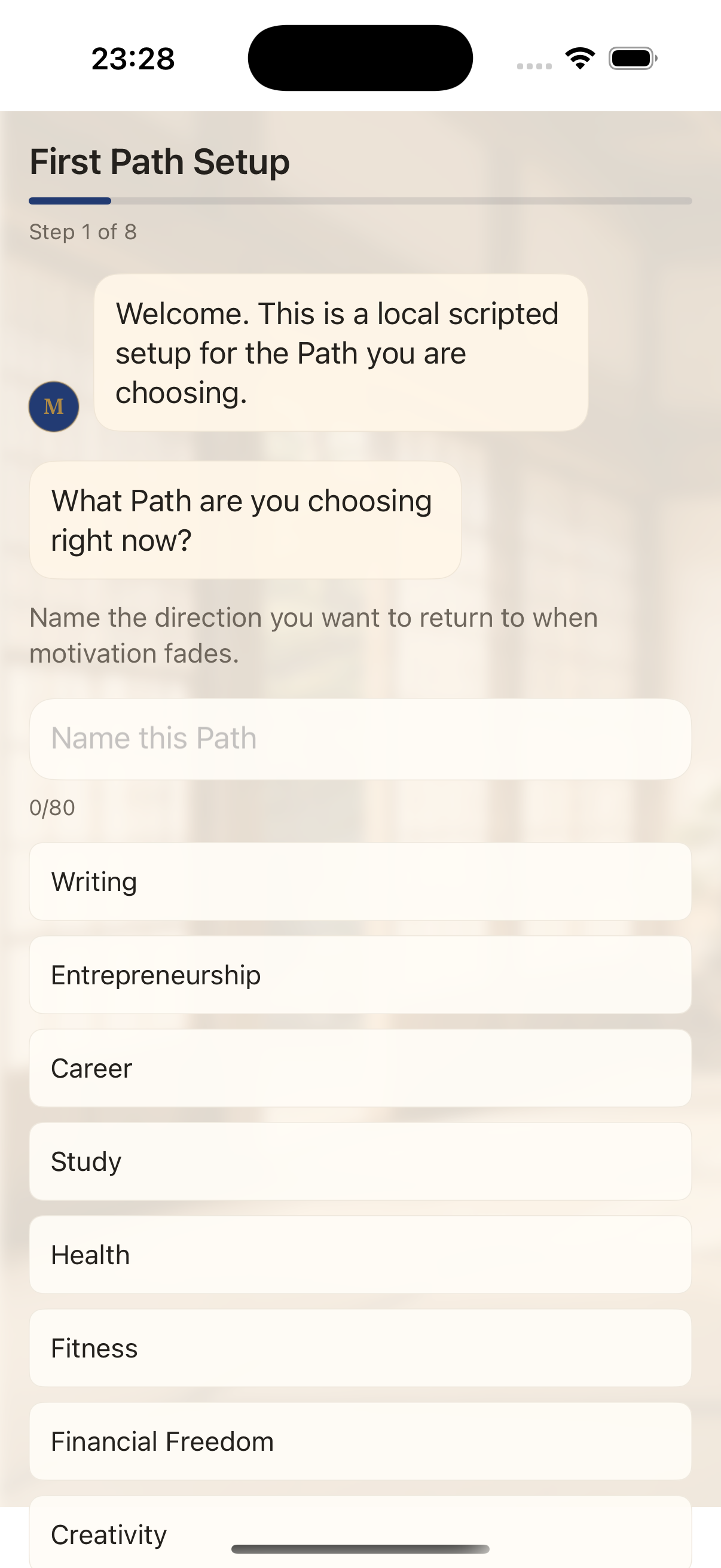
Define the Path, larger goal, transformation, reason, practice, friction, recurring excuse, and guidance style across eight saved steps.
Store messages locally and prepare on-device replies from a compact packet of relevant Path context.
See one practice beside why it matters and the local obstacle that may be making it harder.
Capture friction, inspect suggested memory changes, and decide what becomes durable Path context.
Inspect an accepted plan, its phases, evolution notes, and narrow adjustments before applying them.
Edit Paths, delete conversations, and remove supported categories of locally stored Path memory.
How it works
The product moves from durable meaning to a small action without turning the process into a score.
Name the direction and the larger outcome that makes it worth pursuing.
Record the transformation, ordinary work, recurring friction, optional reason, and useful guidance style.
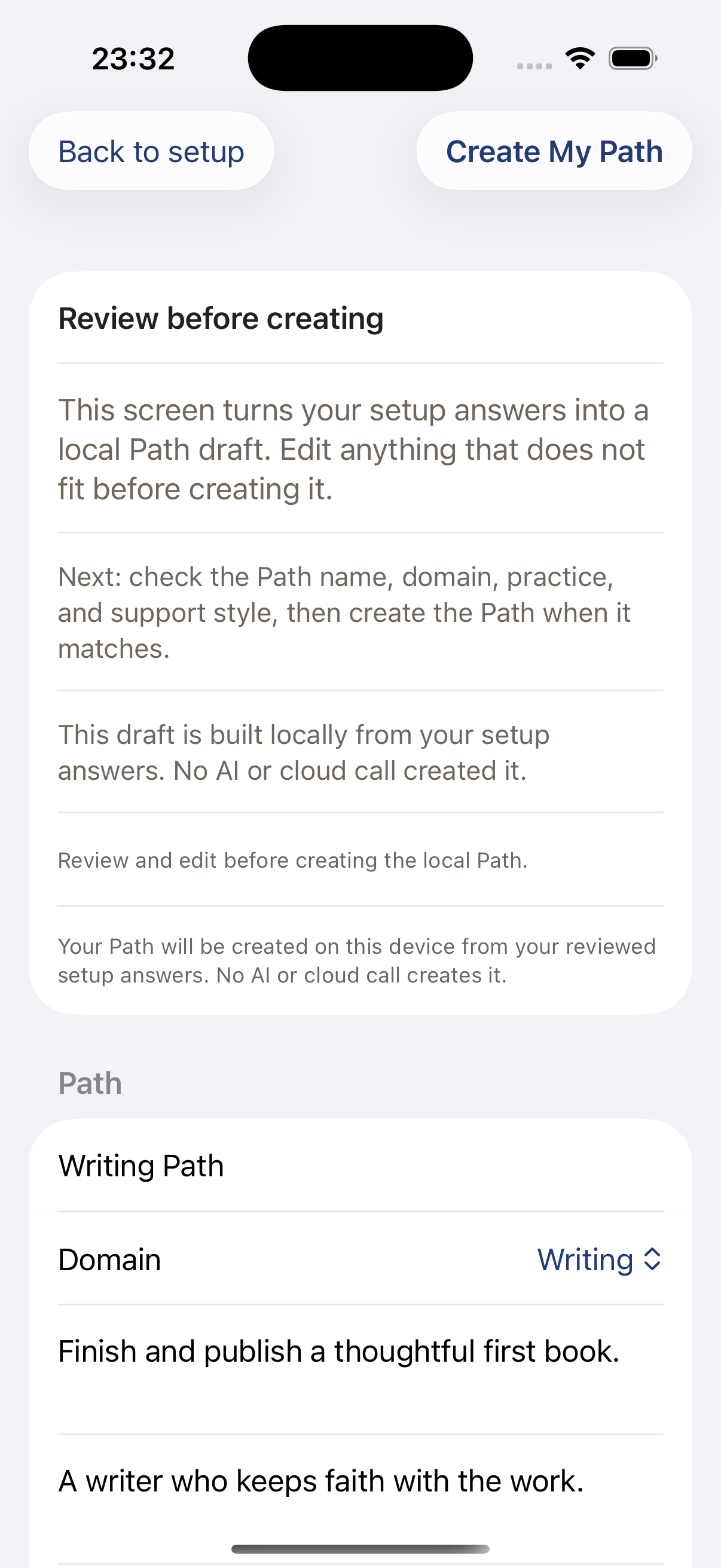
Edit the complete draft before creating the Path on the device.
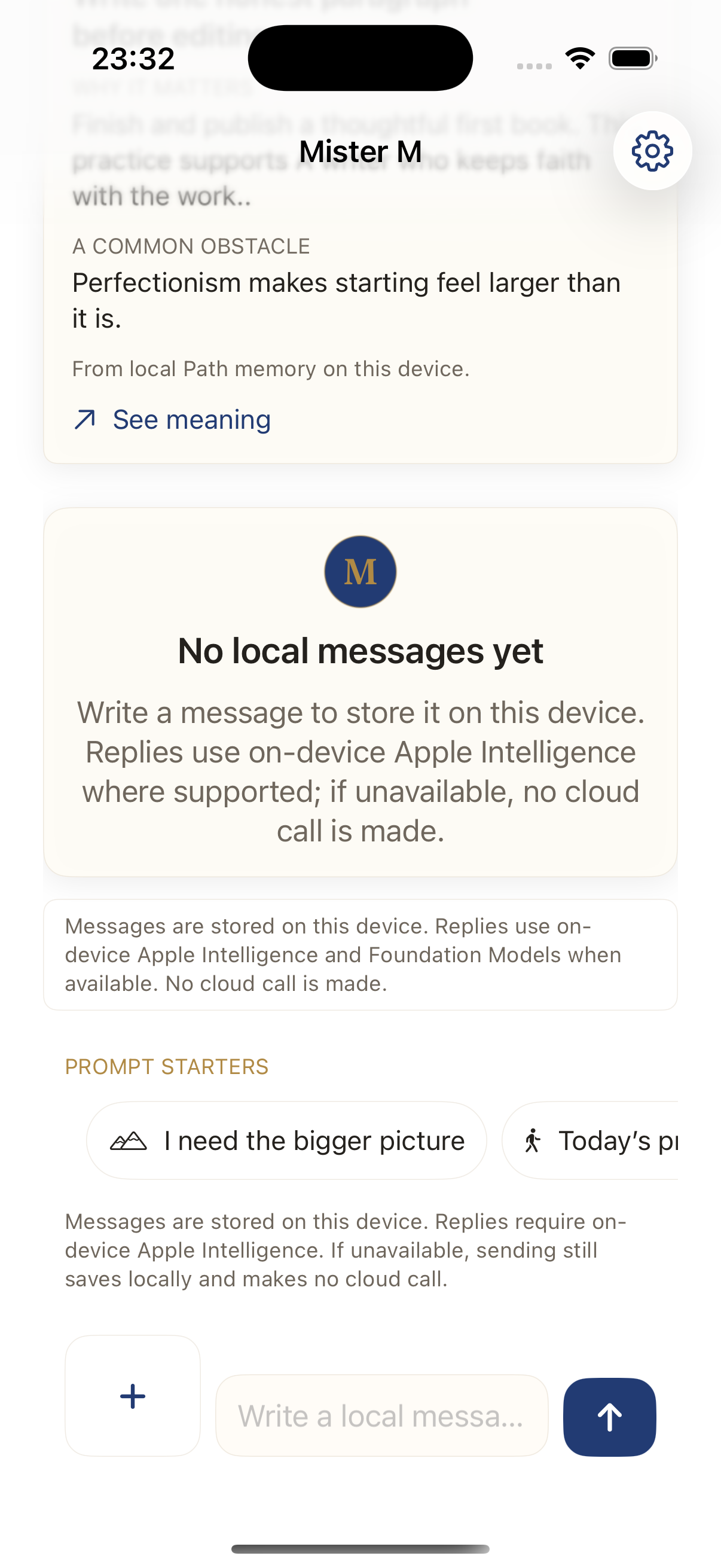
Write what feels difficult or begin from an editable prompt such as I need the bigger picture.
Retrieve relevant context, generate on device when available, validate the candidate, and persist only an accepted response.
Leave with a clearer relationship to one honest next action rather than another dashboard to maintain.
Current interface
Simulator captures from a clean local workflow using fictional sample content.
 View full size
The first setup step names the direction the user wants to return to when motivation fades.
 View full size
Setup answers become an editable local draft, with no model or cloud call creating the user's Path.
 View full size
Prompt starters remain editable, user messages stay on device, and unavailable generation does not trigger a cloud call.
Product concept
Mister M is designed for moments when a person knows what to do but has lost emotional contact with why the repeated action matters.
The product supports voluntary return rather than measuring obedience through streaks, reminders, pressure, or shame.
A Path connects the goal, desired transformation, practice, friction, reflection, and preferred form of guidance.
The application stores reviewed facts locally. Generated suggestions do not become durable truth without an explicit review path.
Architecture
Local structured memory, deterministic policy, and guarded persistence surround the on-device generation step.
SwiftData stores Paths, practice, friction, conversations, reflections, plans, preferences, permissions, and related state behind repository protocols.
Code selects context, applies safety and quality policy, controls memory changes, and decides whether generated output may be shown or stored.
If on-device generation is unsupported or fails validation, the user's message remains local and no synthetic or cloud reply replaces it.
Optional planning has minimized draft contracts and validation boundaries, but the current runtime has no configured transport or live provider call.
Technology
Development
The iPhone application, local persistence, Path experience, and guarded Foundation Models pipeline are working and heavily tested. Release distribution, live-model quality, real-device persistence, accessibility, and the manual ledger remain unverified.
Implemented
Release focus
Reconcile deployment and capability gating, decide the first-release scope, complete supported-device and live-model testing, validate persistence, deletion, and accessibility manually, then finish public privacy, support, and distribution materials.
Mister M lab notes
Notes about the thinking, architecture, development, and decisions behind this work.
Optional cloud planning began as a consent and review boundary, not as a hidden fallback for daily guidance.
Practice, friction, reflection, reviewed suggestions, and return without streaks gave the Path concept practical weight.
The critical step was defining what the application must decide before and after a model supplies candidate language.
The first implementation began from a narrow Path-centered promise instead of starting with an unbounded chatbot and searching for a purpose.