
See the tactical proposition
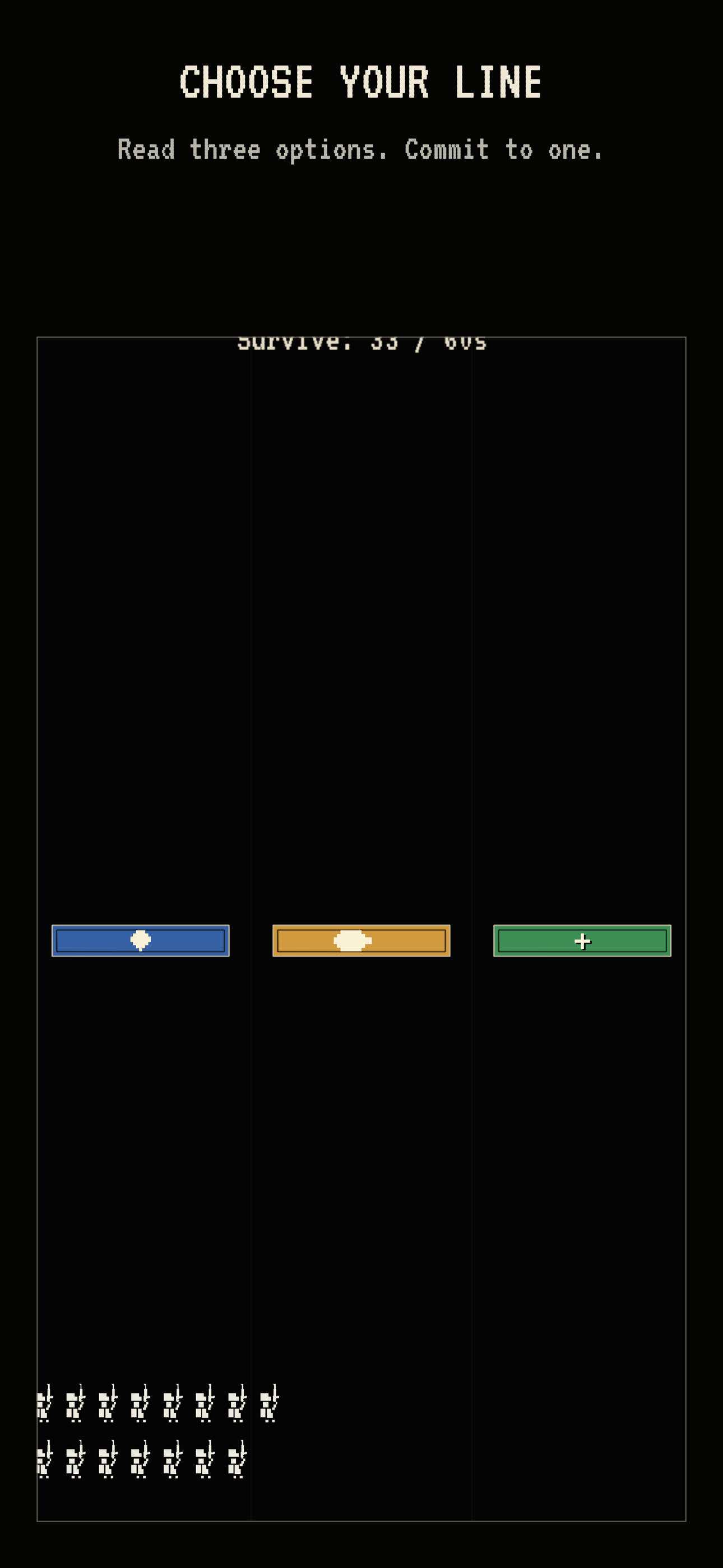
Read gates, rewards, enemies, and objective pressure inside a compact portrait battlefield.
An offline portrait strategy-action game where the player steers a compact army across three lanes and carries each commitment into later threats.
Currently free on the App StoreHow much strategy can fit inside one tense, readable run?
Visible lane tradeoffs, automatic combat, army preservation, deterministic battle plans, and same-battle retry make each loss understandable and each correction comparable.
User value
Move a compact army between three lanes, accept visible rewards or risks, and retry a stable battle to test a better route.
Read gates, rewards, enemies, and objective pressure inside a compact portrait battlefield.
Preserve soldiers, ammunition, formation, weapons, and temporary powers for the threats that follow.
Retry the same versioned plan and stable random sequence so a changed outcome reflects changed commands.
 View full size
Features
The current playable path combines lane movement, automatic combat, resource state, objective pressure, pause, and immediate results.
Swipe left or right by one lane and commit the army to the gate, reward, or threat ahead.
Let the game handle firing, projectiles, contact, and most timing while you focus on position and preparation.
Track soldiers, ammunition, formation, active weapon or power, damage, and objective progress as the run develops.
Stay alive for a target duration or remove the required share of enemy strength before the battle resolves.
Choose among three worlds, four runs per world, and visible survival or annihilation modes in the current menu.
Fifteen versioned battle definitions, progression, objectives, results, retry, and migration exist in domain logic; final production UI connection remains unconfirmed.
How it works
Direct input stays narrow so attention remains on the consequences of lane position.
Choose a world, run, and survival or annihilation mode from the visible menu.
Compare the rewards, costs, enemies, and future pressure shown across the field.
Swipe one lane at a time while automatic combat continues around the formation.
Preserve soldiers and useful battle state for the gates, threats, and assaults still ahead.
Survive the required duration or eliminate enough enemy strength to reach the result.
Restart the fixed plan to test a corrected route without silently changing the battle underneath it.
Product demos
Current campaign media
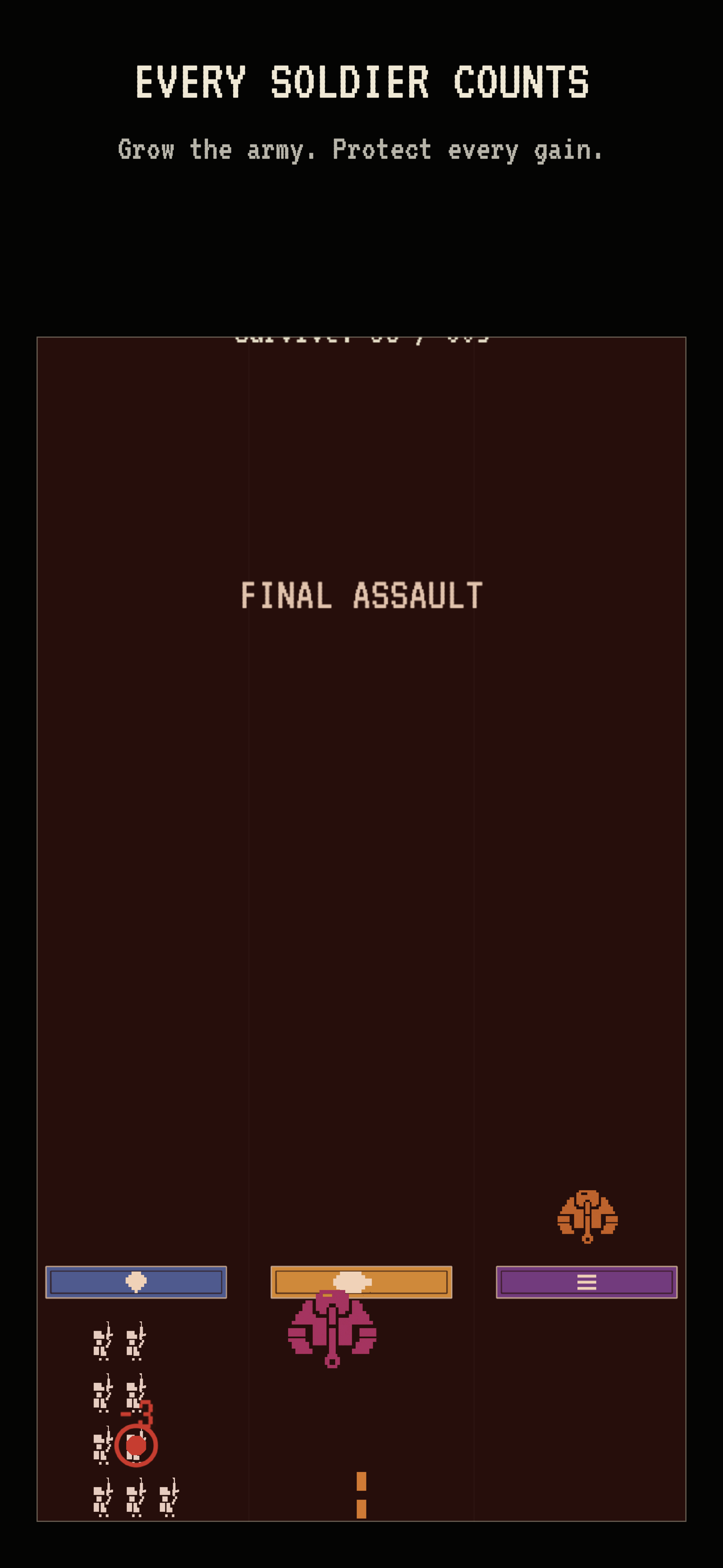
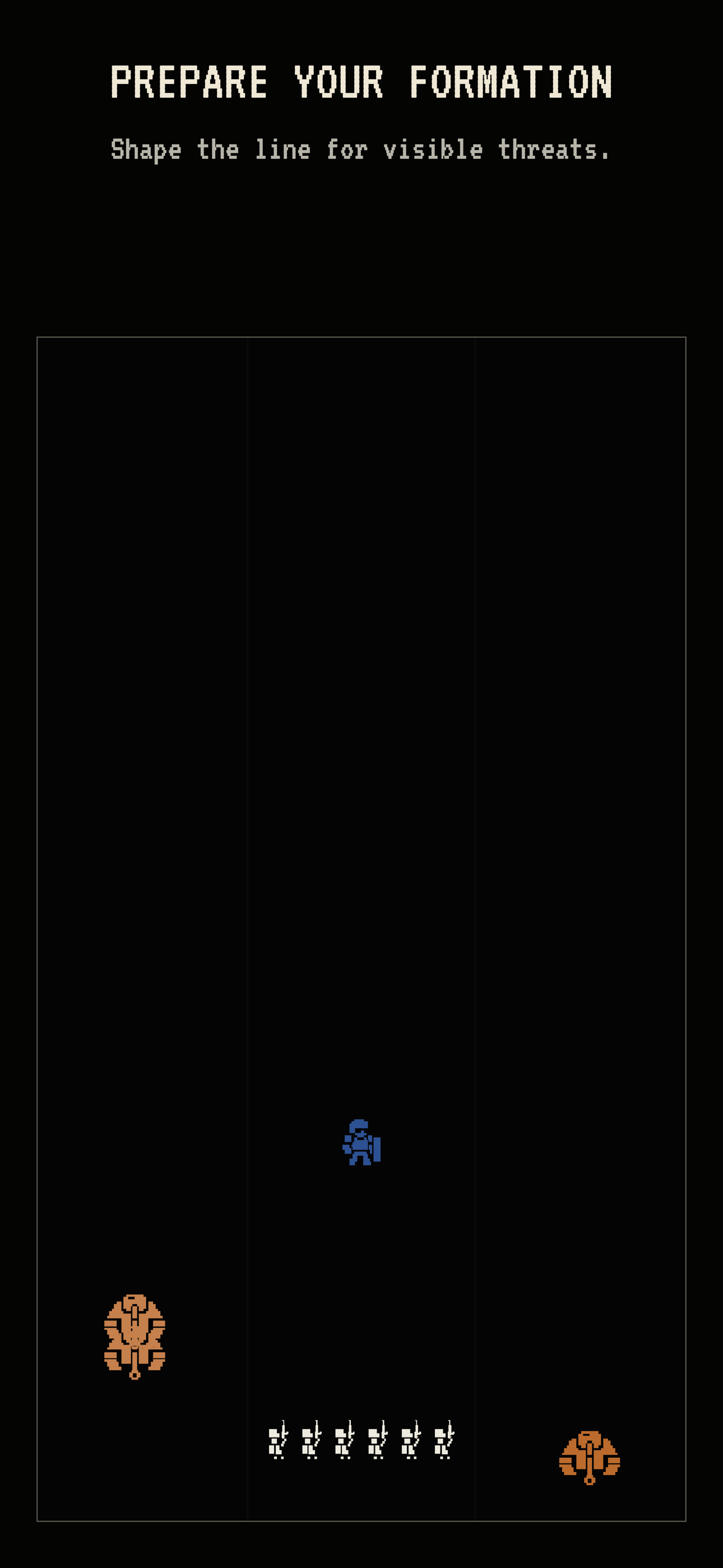
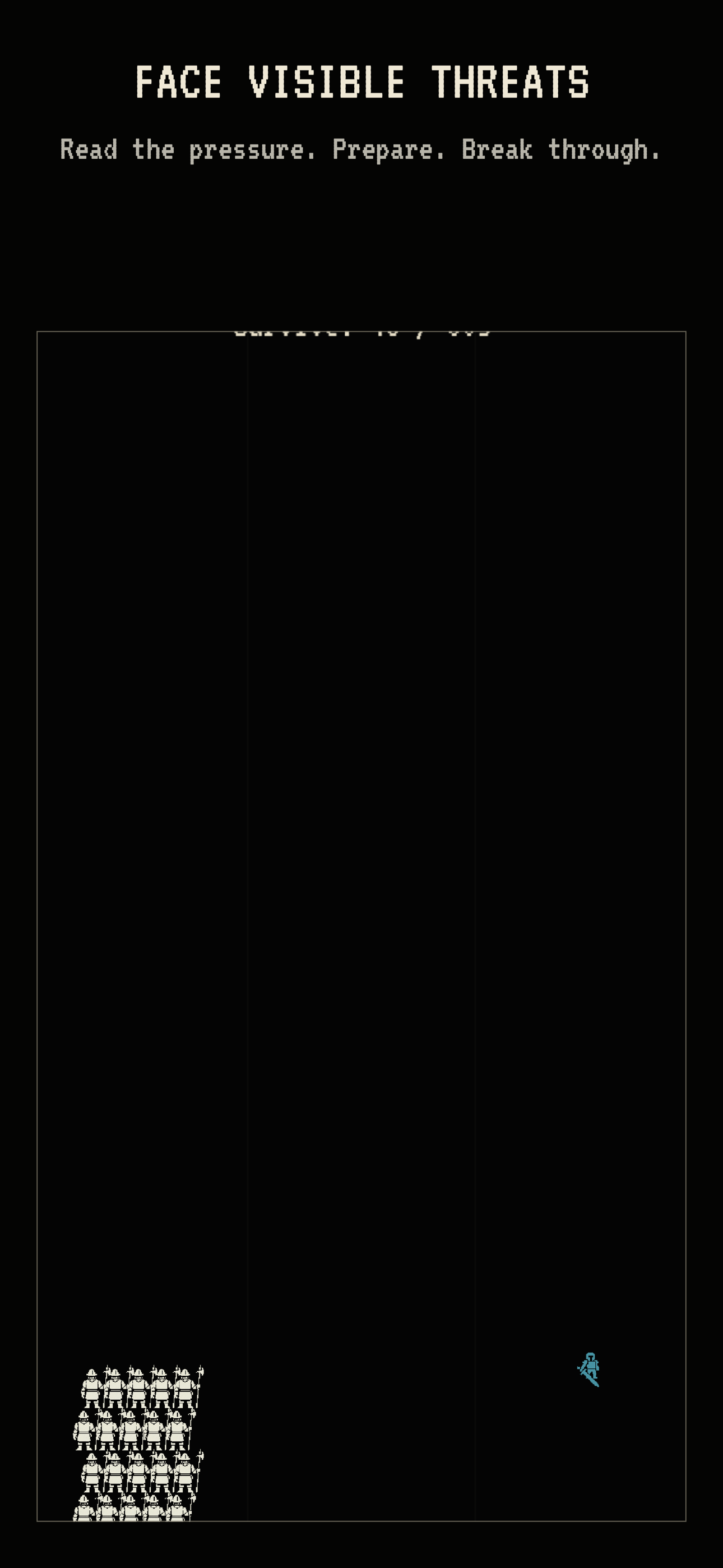
These application-rendered Debug captures are composed App Store assets with embedded headlines, not neutral in-game screenshots.
 View full size
Earlier gains remain visible when the army reaches a later assault.
 View full size
Army shape and lane position become preparation for visible threats.
 View full size
A sparse field keeps the army, enemy, and objective relationship readable.
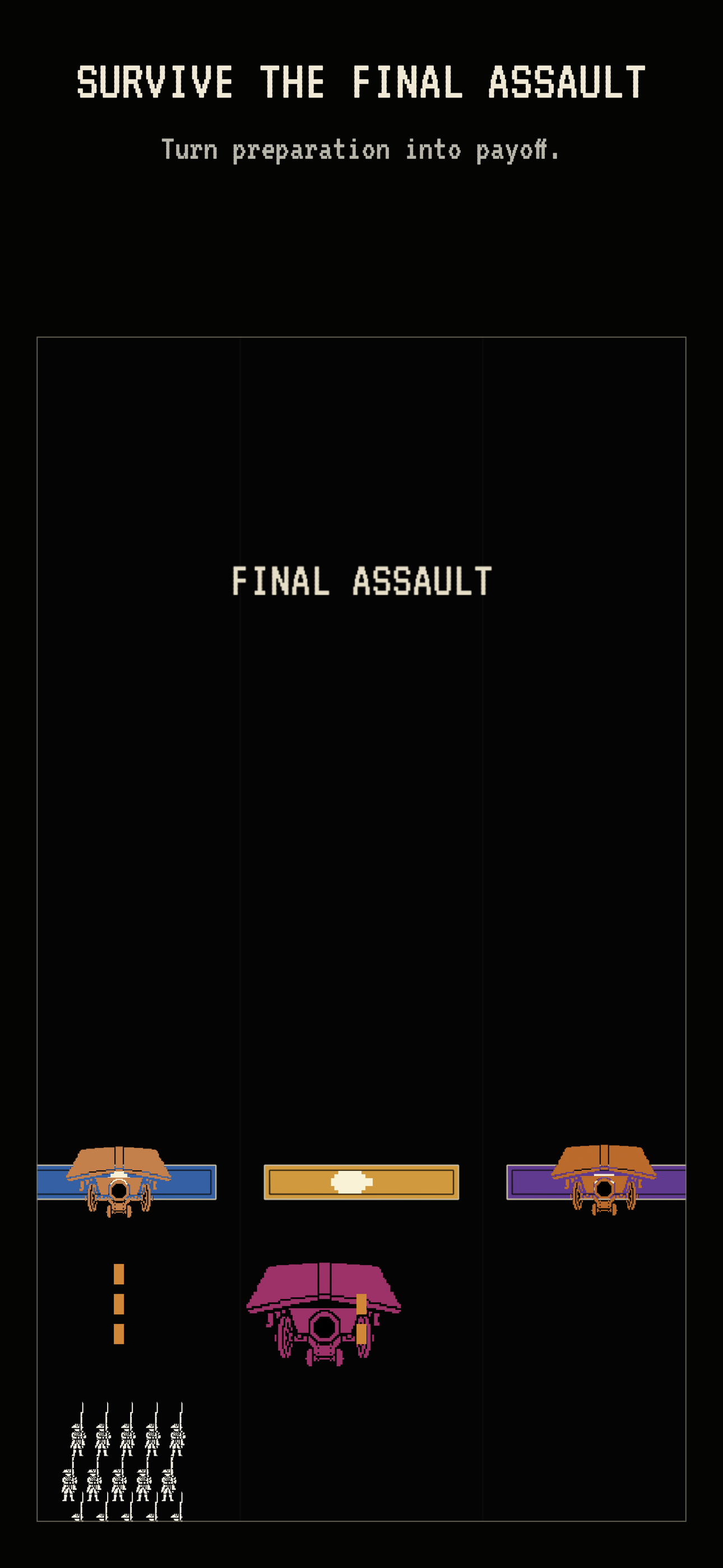 View full size
Later encounters convert previous preparation into a direct multi-lane test.
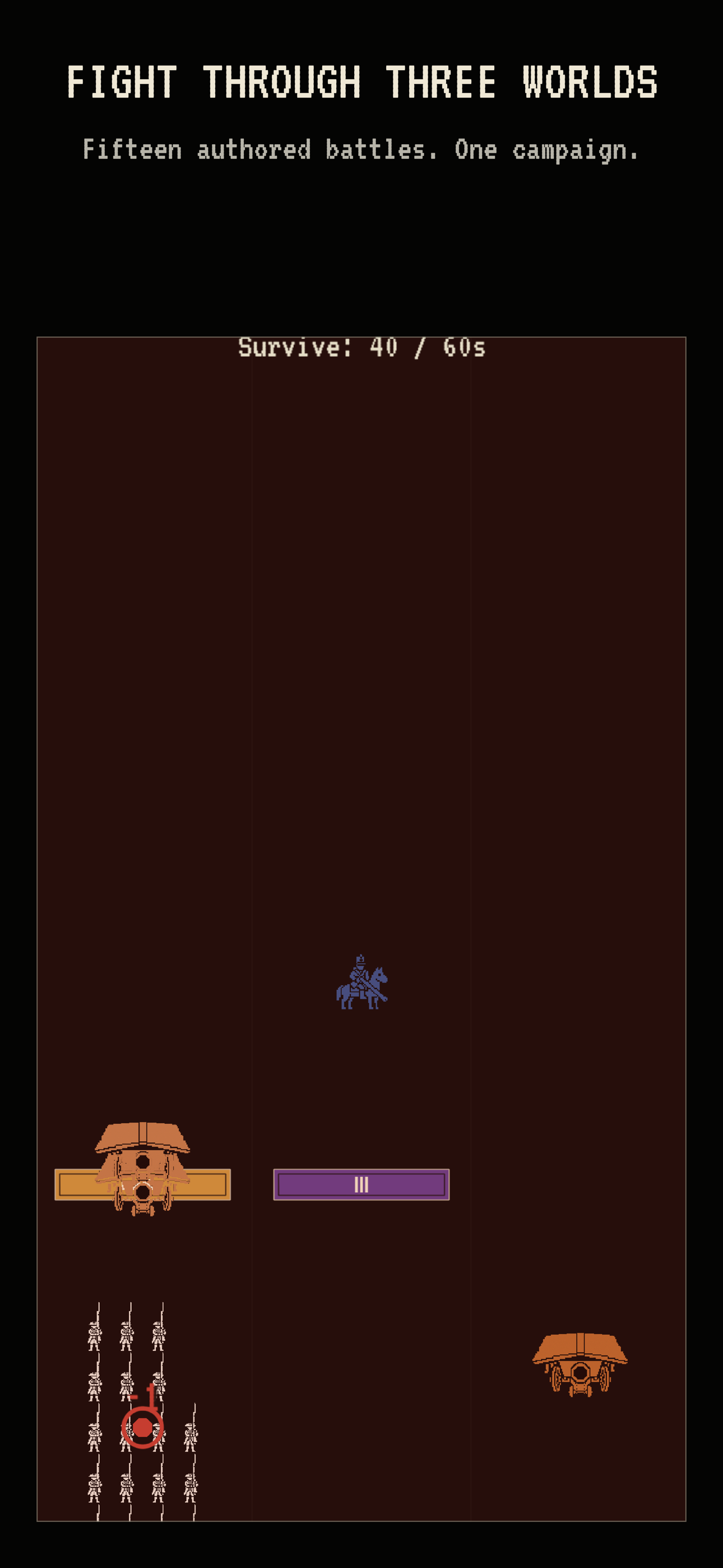 View full size
Campaign media presents different silhouettes and pressure across the world identities.
Product concept
A difficult battle can still teach the player when its choices, losses, and retry identity remain understandable.
Movement is direct while attacks are automatic, keeping the decision on which tactical proposition to accept.
Versioned plans and random streams let a retry serve as a meaningful counterfactual rather than a new roll of the dice.
Bots, simulations, and structural metrics provide engineering evidence while human readability and enjoyment remain separate review questions.
Architecture
Typed commands and deterministic Swift state define the battle while SpriteKit presents soldiers, gates, enemies, projectiles, feedback, and results.
Versioned plans, stable random streams, checksums, recordings, and compatibility rules bind replay and retry to exact content.
Headless battles, bots, paired experiments, balance analytics, and golden scenarios exercise canonical rules outside SpriteKit timing.
The adversarial Director compiles immutable deterministic plans in Debug and is rejected as a normal Release activation path.
The inspected runtime has no networking, account, remote database, analytics, advertising, telemetry, or AI service.
Technology
Development
The repository contains v0.9.3 build 3 release-candidate packaging, campaign media, extensive deterministic systems, and an owner handoff. Public distribution is unknown, the authored campaign's production UI and durable save path are unclear, and the Debug-only Director still awaits human review.
Implemented
Production reconciliation
Confirm the public name and distribution status, connect or document the authored campaign's production menu and gameplay path, implement or verify durable on-device campaign persistence, add an end-to-end save and resume test, complete Director human review, and perform physical-device accessibility validation before any owner-controlled release action.
Pixel Battleline lab notes
Notes about the thinking, architecture, development, and decisions behind this work.
A Debug-only deterministic search system began constructing immutable three-lane dilemmas for subjective review.
The v0.9.3 package joined release evidence, truthful media, rollback material, and an explicit list of owner actions.
Fifteen versioned battles connected lane commitment to a structured three-world campaign model.
Versioned plans, stable randomness, fixed ticks, and recorded commands gave each battle a reproducible identity.