
Experience the analysis
Commentary acts through timing, replacement, fading history, page movement, blackout, and text-machine imagery instead of sitting beside the novella.
A deterministic literary web experience that performs The Metareverse, analyzes its language, remembers the reader's choices, and returns them as later callbacks.
What exists beyond reading an electronic book?
Authored analysis, timed typography, text-machine imagery, interpretive decisions, and persistent memory make the page feel attentive without generative AI or alternate story canon.
User value
Encounter The Metareverse through a performed analysis that asks what words, signals, and evidence should remain.
Commentary acts through timing, replacement, fading history, page movement, blackout, and text-machine imagery instead of sitting beside the novella.
Choose a word, signal, fact, or piece of evidence at authored decision points throughout the available journey.
The experience remembers selected decisions and acknowledges them later while preserving the story's fixed outcome.
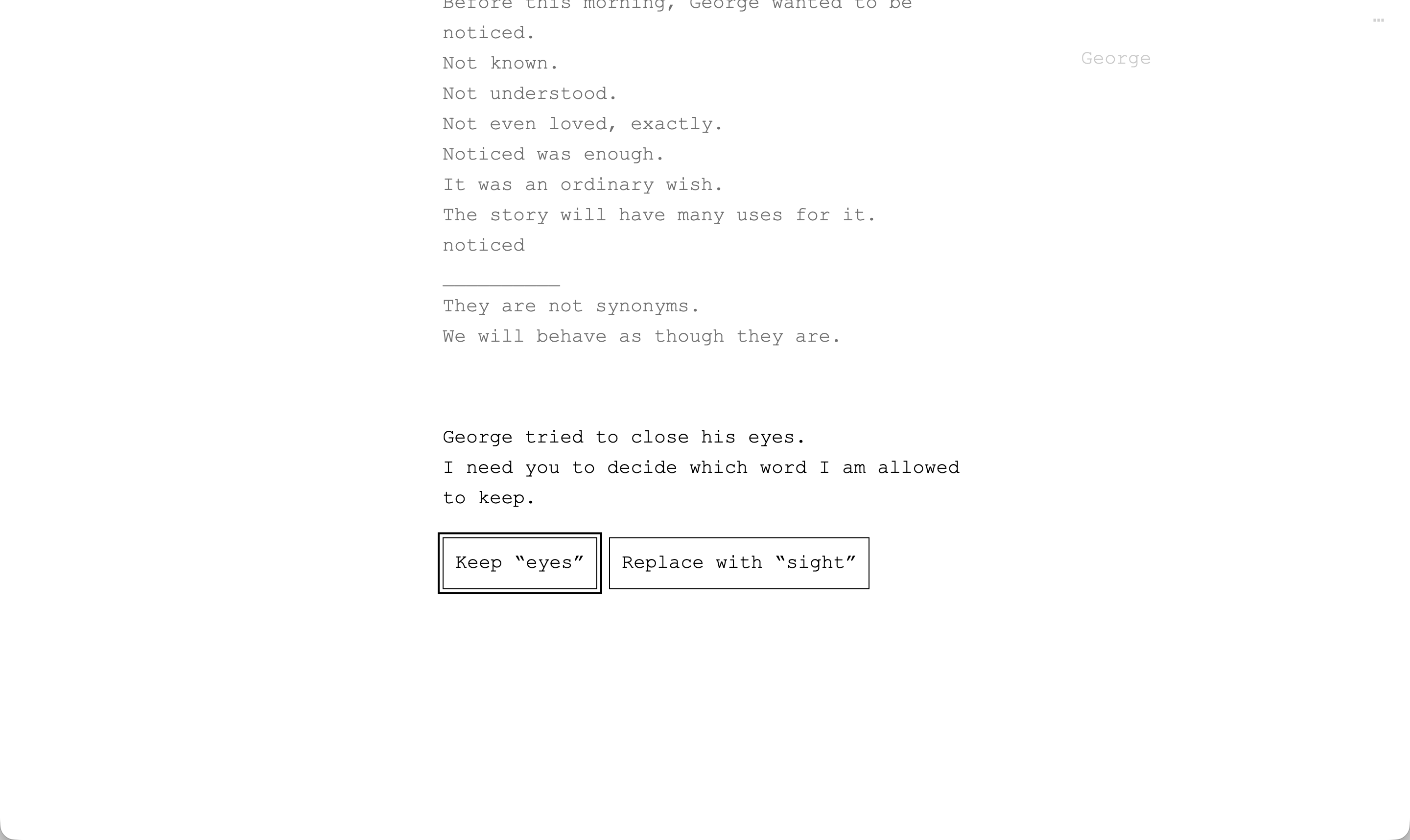 View full size
Features
The current second prototype turns approved story material and analysis into a responsive, locally remembered reading experience.
Move through the P0.1 prologue, seven chapters of Part I: Visibility, and seventeen chapters of Part II: Witness through P2.17.
Make two prologue choices, seven Part I choices, and seventeen four-way Part II choices with no free-form input or hidden scoring.
Carry earlier choices into later approved wording and records while every branch converges on canonical events.
Use timed presentation, visible revision, selectable history, text-machine illustrations, rotation, and blackout as part of the analysis.
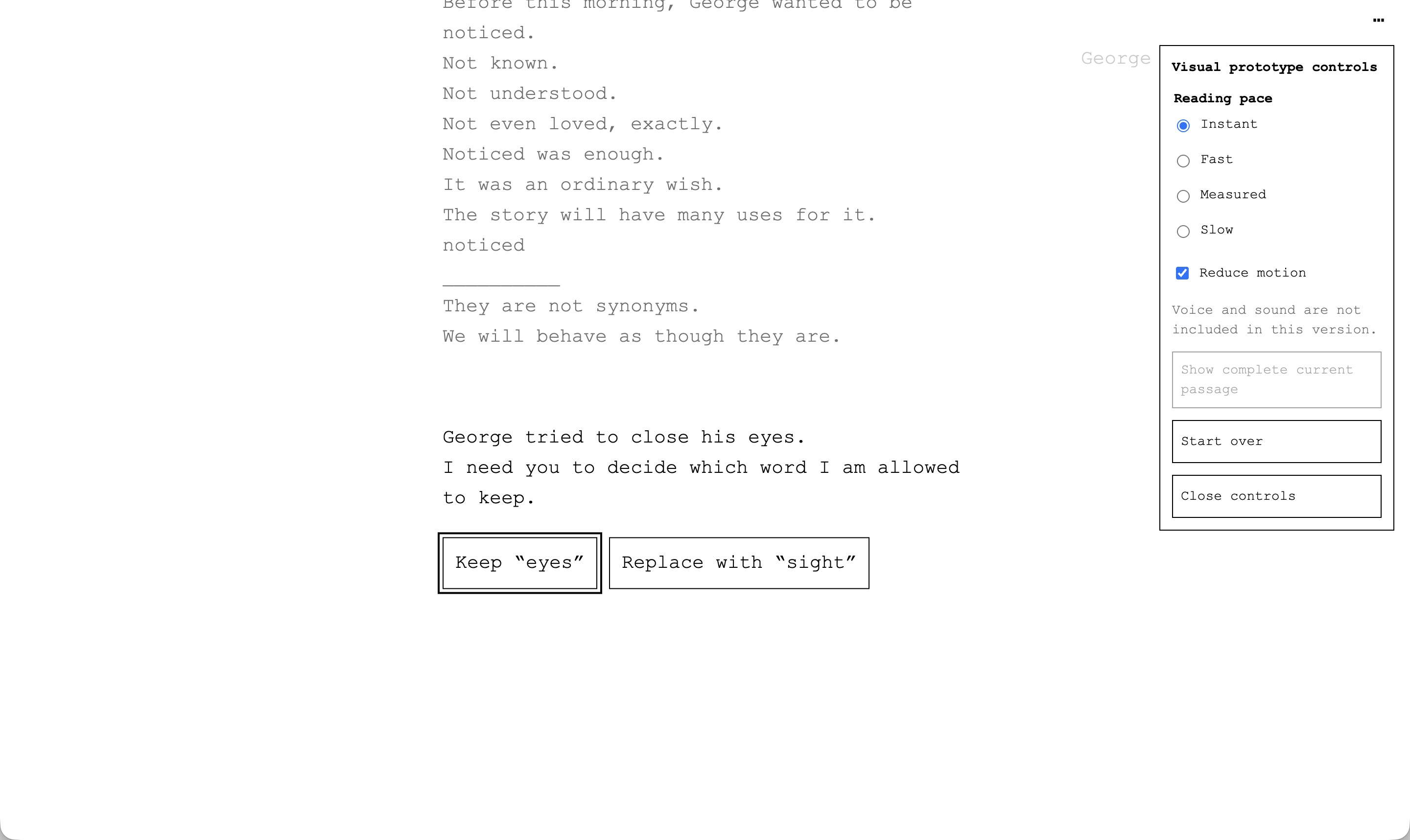
Choose Instant, Fast, Measured, or Slow pace, reduce motion, reveal a complete current passage, or restart the experience.
Resume the correct phase and retained choices from a validated browser record without an account or remote narrative service.
How it works
Participation changes the analytical record and later language, not the canonical events of the novella.
Activate the experience and let authored text, pauses, and visual transformations establish the analytical intelligence.
See the intelligence question a word, classification, signal, or piece of evidence inside the story itself.
Select from named interpretations without time pressure, free-form input, or a hidden correct answer.
Let the selected choice shape immediate wording and remain available to later deterministic callbacks.
Return through browser-stored progress or start over and delete the current narrative record.
In practice
 View full size
A compact panel exposes pacing, reduced motion, passage reveal, restart, and the current absence of voice and sound.
 View full size
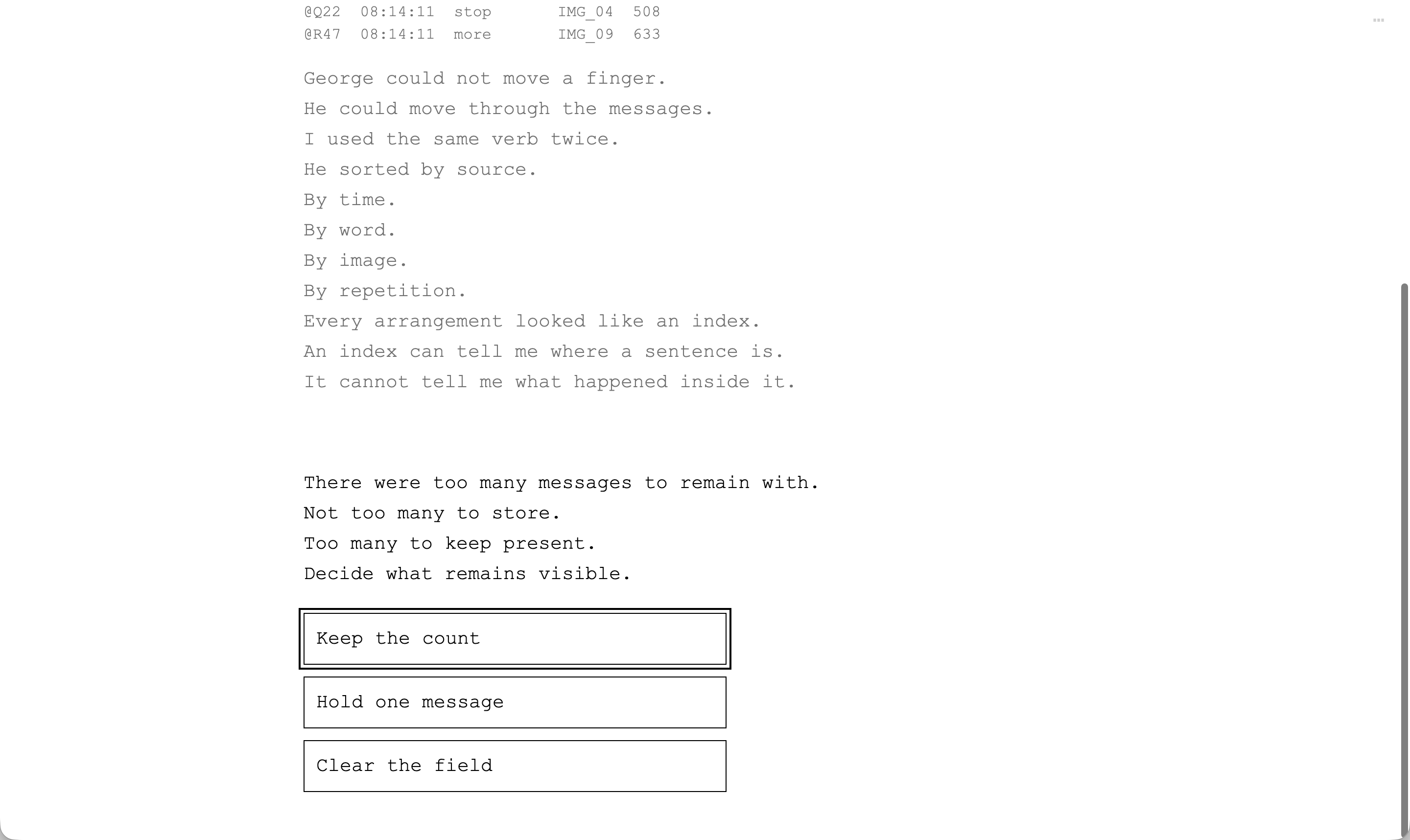
Part I turns a field of messages into a choice between preserving the count, holding one message, or clearing the field.
 View full size
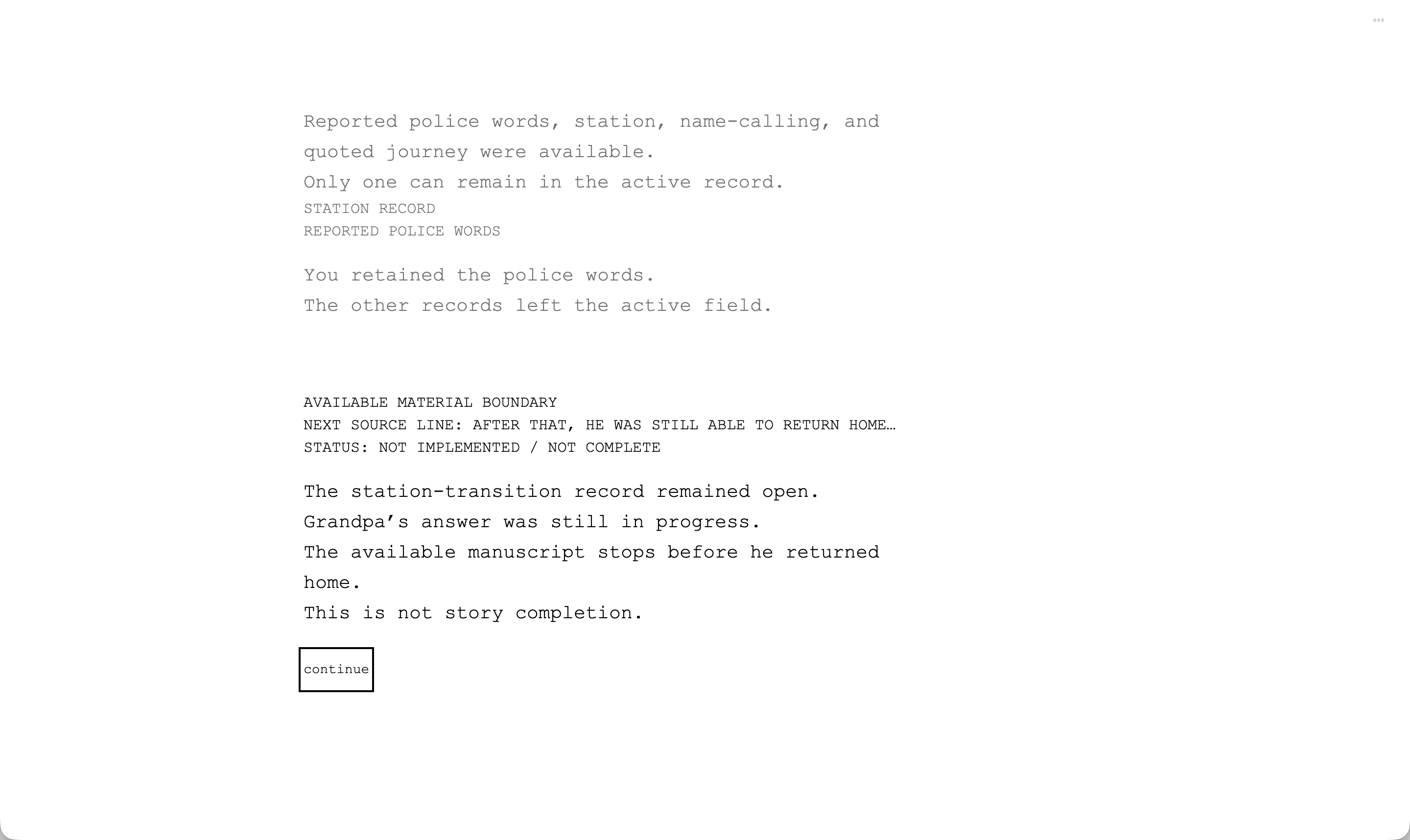
The prototype identifies the P2.17 boundary and states that the current endpoint is not story completion.
Product concept
OnTheMetareverse combines a novella, literary analysis, interaction design, and deterministic narrative memory in one authored form.
Words are retained, revised, faded, classified, and recalled through the page instead of explained in a separate commentary layer.
The reader influences language and evidence without rescuing George, earning a score, or creating an alternate canon.
Attention, doubt, memory, and responsiveness come from prepared branches and callbacks rather than runtime generation.
Architecture
A separate React application resolves approved fragments against retained choices, presents timed sequences, and stores validated progress locally.
Typed declarations and resolver functions select the same approved result for the same state and reader choices.
The prologue, Part I, and Part II can change page behavior while sharing retained choices and local progress.
IndexedDB stores versioned narrative snapshots and localStorage stores pace and motion preferences.
The implemented experience uses no runtime model, narrative API, account, analytics integration, or cloud persistence.
Technology
Development
The approved prologue, Part I, and available Part II material are implemented and tested. The experience is not narratively complete or approved for canonical publication.
Implemented in the second prototype
Before a complete published experience
Continue only after P2.18 and later material are approved. Supply the required font, recorded voice, and authored sound assets, then complete manual creative, cross-browser, accessibility, publication-rights, and canonical release review.
OnTheMetareverse lab notes
Notes about the thinking, architecture, development, and decisions behind this work.
The second prototype makes the approved visual experience testable without substituting missing voice, sound, or story material.
A digital book can do more than reproduce pages. The question is whether software can become part of interpretation without displacing the work itself.