
Preserve the source trail
Retain source bytes, checksums, parser versions, transformations, validation outcomes, and field provenance with the customs record.
A Mexico-focused customs review system that turns supported pedimento XML into traceable data, deterministic signals, reports, and audit evidence.
What if every customs review signal remained connected to its source and interpretation?
Governed ingestion, versioned parsing, canonical customs records, explicit rules, durable processing, tenant isolation, and human review preserve the evidence chain from file to finding.
User value
Move from selected Mexican customs records to normalized facts, explainable signals, and exportable evidence without treating software output as a legal conclusion.
Retain source bytes, checksums, parser versions, transformations, validation outcomes, and field provenance with the customs record.
Evaluate canonical data through constrained, versioned rules that identify the rule, context, and bounded evidence behind each finding.
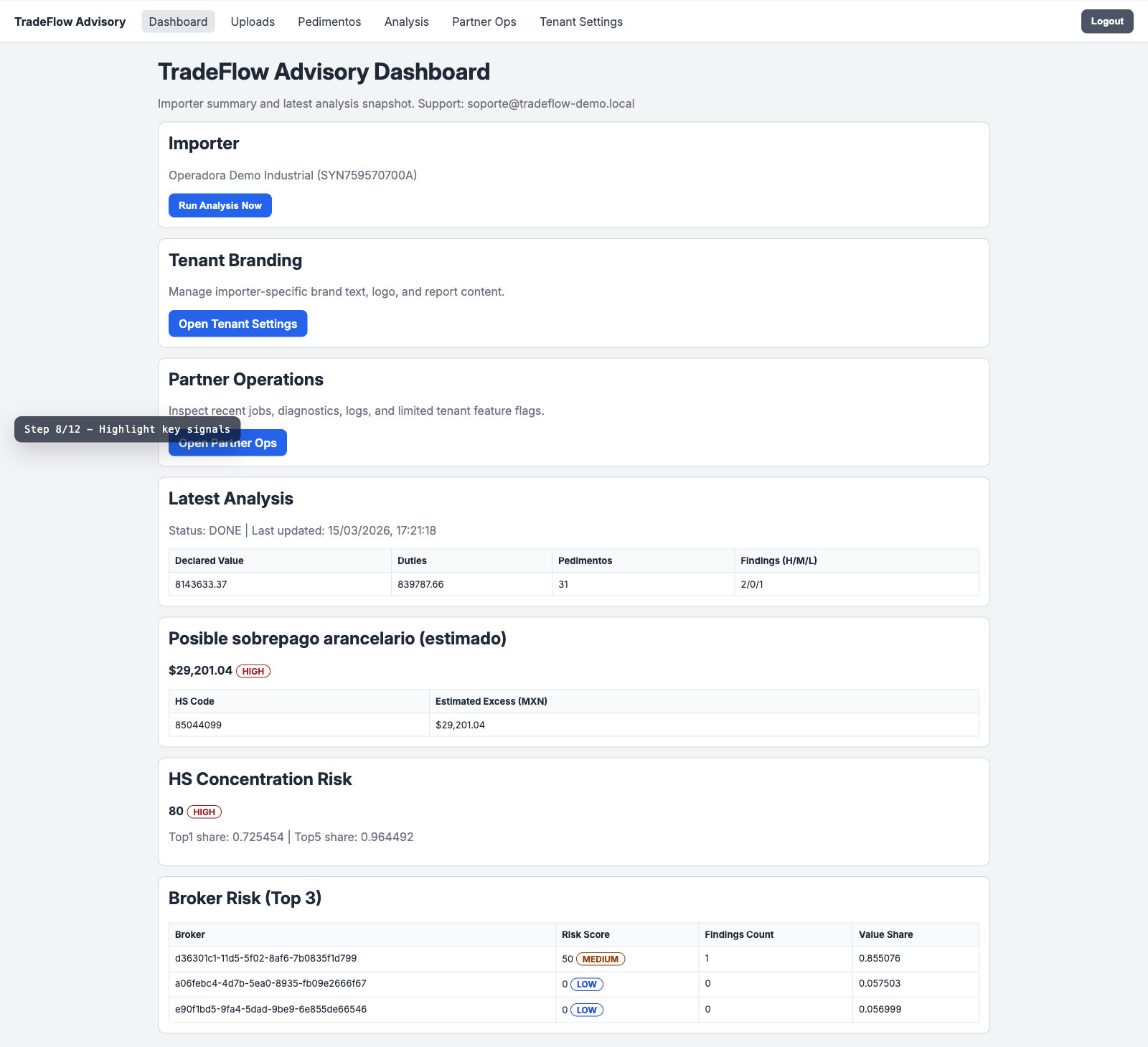
Inspect runs and findings in the browser, render the current HTML report, and download an audit packet for further assessment.
 View full size
Features
The current system connects protected workspaces, source lifecycle controls, customs normalization, deterministic analysis, and export.
Accept individual, bounded archive, API, and SFTP-backed submissions with validation, malware quarantine, duplicate detection, provenance, retention, and legal holds.
Convert supported XML into canonical pedimento and line-item records while preserving decimal, date, missing, blank, invalid, and zero semantics.
Represent declaration families, versions, rectification relationships, effective views, controlled reprocessing, and evidence-derived official status.
Run five versioned baseline rules without arbitrary supplied code, hidden network behavior, or authoritative binary floating-point calculations.
Apply secure sessions, passkey MFA, roles, machine identities, support controls, audit events, and PostgreSQL row-level tenant isolation.
Use English or Spanish interface copy and configure product identity, support text, report copy, and selected capabilities for each tenant.
How it works
Each stage adds context while keeping the route back to the submitted source visible.
Sign in, complete configured MFA, and select the importer or tenant context before accessing data.
Upload pedimento XML or use an implemented machine intake path and follow durable processing status.
Validate, quarantine, scan, store, deduplicate, retain, hold, or delete source material through explicit states.
Parse supported fields, validate the domain model, connect declaration history, and preserve provenance.
Evaluate a versioned ruleset against the importer-scoped population and store attributed findings.
Review the run, findings, summaries, HTML report, and current audit packet before qualified human disposition.
In practice
 View full size
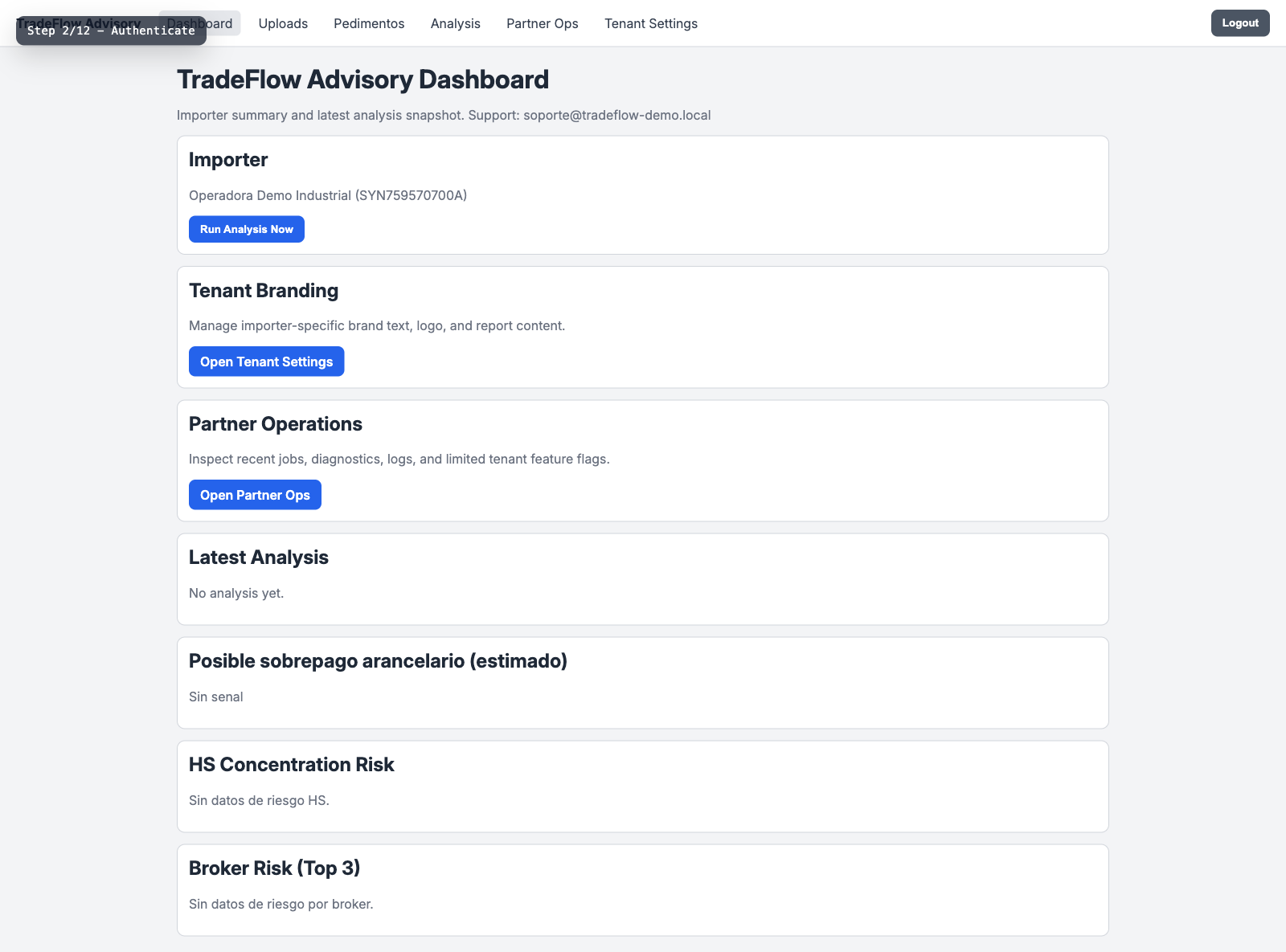
The dashboard shows the active importer, tenant configuration, operations access, and empty analysis states before processing.
 View full size
The upload register distinguishes parsed records from deliberately malformed synthetic fixtures that reached a failed state.
 View full size
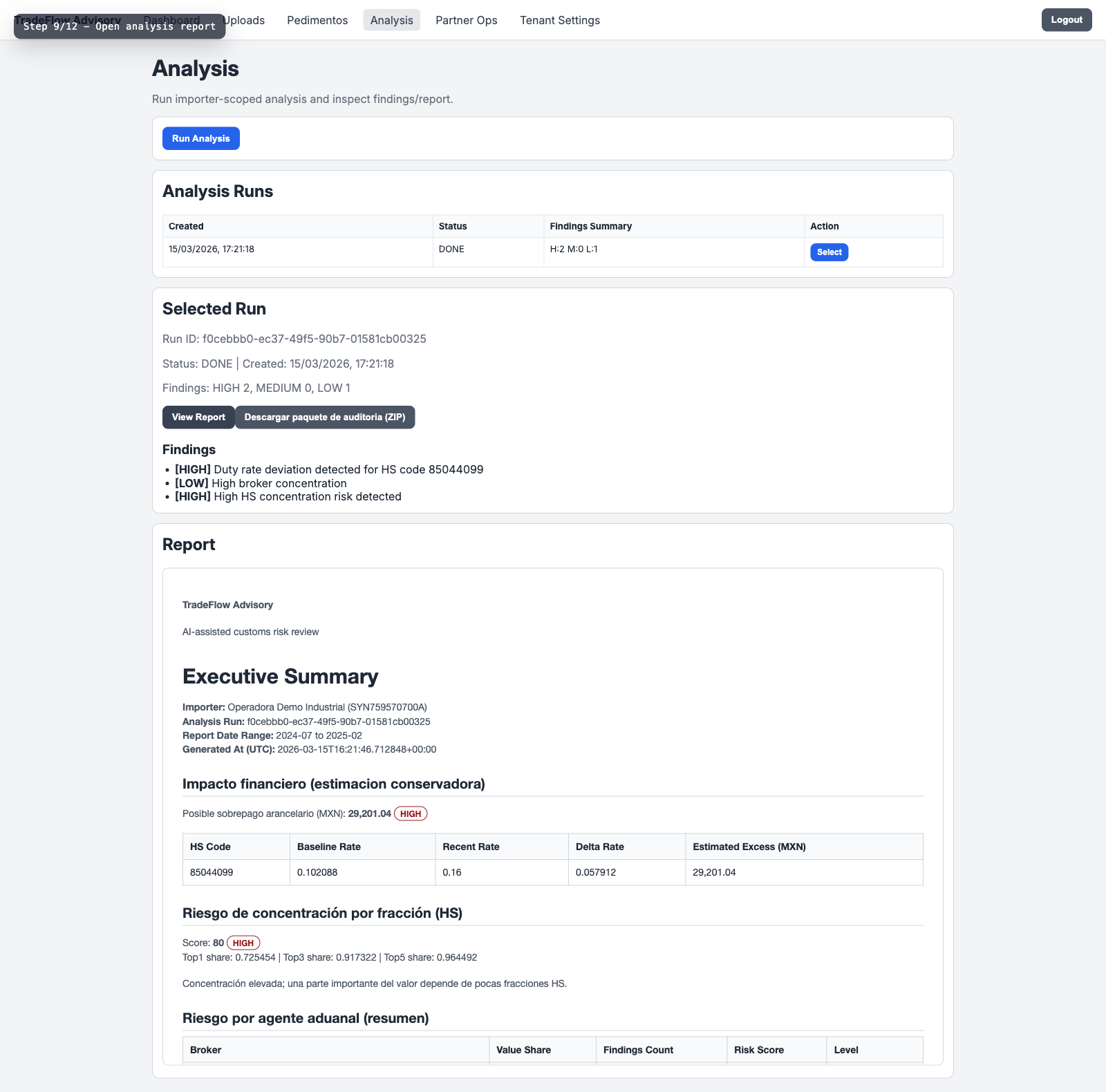
A completed run exposes finding counts, named signals, report viewing, and the current audit-packet download path.
Product concept
TradeMind MX treats customs review as a chain of source, interpretation, rule context, finding, and human responsibility.
Normalized customs data remains connected to source bytes, transformation versions, validation, and field or relationship evidence.
Deterministic rules identify conditions for qualified review without replacing regulated professional judgment.
Durable jobs, versioned parsers, rule identity, context attribution, and governed source state make repeated review inspectable.
Architecture
The React browser uses a FastAPI service. PostgreSQL remains authoritative for business data and job state while workers process governed source objects through explicit stages.
Redis delivers work hints while database jobs record claims, heartbeats, retries, recovery, and material completion state.
Provider-neutral object storage uses opaque keys, quarantine eligibility, retention, legal holds, tombstones, and controlled physical purge.
Central authorization and PostgreSQL row-level security scope workspace data even when API or worker paths change.
Typed context, stable rule versions, bounded evidence, and execution limits support repeatable analysis without arbitrary code or an opaque model.
Technology
Development
Four foundation phases are accepted and Phase 5 has begun with the declarative rules engine. Rule governance, human finding workflows, campaigns, immutable reports, and later customs workflows remain incomplete.
Implemented foundations
Next product layer
Complete proposal, approval, effective-date, release, activation, and rollback governance for rules. Then add human finding disposition, evidence, cases, campaigns, historical reevaluation, persisted report artifacts, integrity manifests, independent benchmark review, and final security, accessibility, legal, and domain qualification.
TradeMind MX lab notes
Notes about the thinking, architecture, development, and decisions behind this work.
Five baseline checks gained stable identities, versions, bounded evidence, and explicit analysis-context attribution.
Canonical pedimento records, declaration history, and provenance gave later rules a specific interpretation to evaluate.
Validation, quarantine, provenance, retention, and legal holds turned file upload into an explicit source lifecycle.
A frozen product and architecture baseline separated the intended evidence-first system from the features already implemented.
The first working path connected authentication, pedimento intake, deterministic analysis, reporting, and browser review.